For the primal solution, please refer to the Newton-ILU case above (with Nonlinear solver iterations limited to 50) - Adjoint parameters:
- Adjoint output: Drag
- Patch Reconstruction H1: False (??)
- Hessian Scalar Type: -1 (??Mach number for Hessian evaluation)
- Nonlinear Smoother: Newton (solved to 10-6)
- Adjoint Smoother residual converged to 10-6
- Primal truth surrogate not fully converged
- Adjoint truth fully converged
- Adaptation parameters:
- Output Adapted: Drag
- Anisotropy method: Hessian (??)
- Re-meshing method: boundary curved
- Number of adaptation iterations: 2
- hp adaptation space
- Adaptation algorithm: Fixed-Fraction marking
- 30% refining and 20% coarsening fractions
- Target degree-of-freedom increase factor: 1.0
(constant DOF)
- Forward sensitivities are computed
(i.e. dCD/dα with a tangent linearization)
- Serial results:
- Adjoint residual norm converges to 1.8574·10-15 after 2 iterations
- dCD/dα (forward sensitivity): 1.6544·10-3
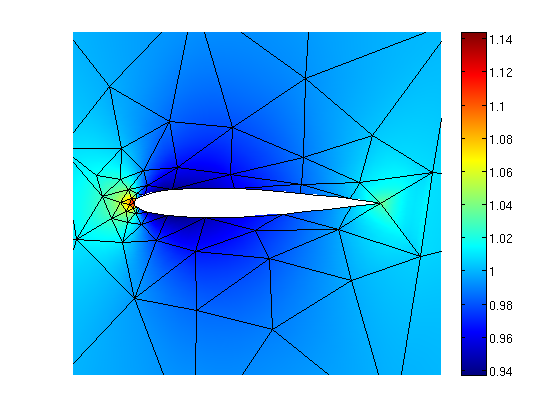
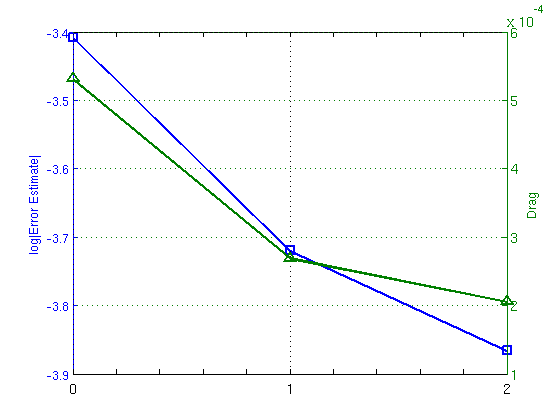
- Initial mesh: DOF = 990; Error estimate = 3.9138·10-4; Drag = 5.3180·10-4
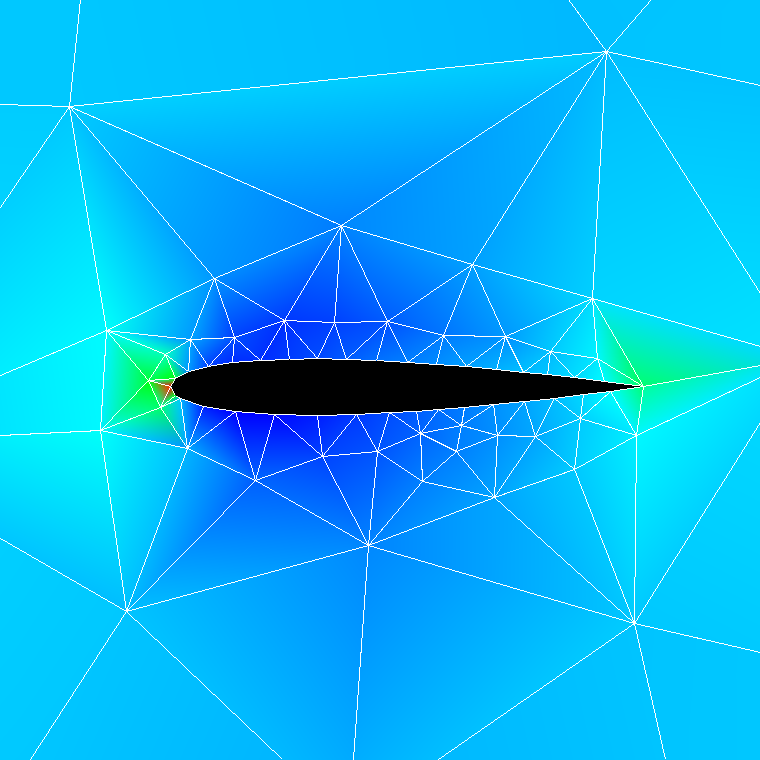
- First adapted mesh: DOF = 1008; Error estimate = 1.9066·10-4; Drag = 2.6942·10-4
- Second adapted mesh: DOF = 1026; Error estimate = 1.3617·10-4; Drag = 2.0600·10-4dCD/dα (adjoint): 1.6544·10-3
|