This page provides documentation about sending digital material to Distinctive Collections (DDC) from the creators or donors of the material. For more information, see the donate digital material page on Distinctive Collection's webpage. As mentioned on that webpage, these steps are only to be undertaken once you have been approved by Distinctive Collections staff. DDC will guide you towards using one of the options described below depending on the size and content of your transfer.
| Table of Contents |
|---|
Archives Transfer Tool (ATT)
The Archives Transfer Tool currently exists as a Dropbox shared folder. Once you have been in contact with Distinctive Collections (DDC) and have created a submission agreement, we will determine the best transfer method for you. If ATT is decided on as the best option, you will be added to a shared folder to transfer files for yourself, DLC, etc.
...
DO need to have an active MIT kerberos account and have logged in at least once to the Dropbox web interface
Do NOT need to install or use the Dropbox application – this is 100% browser based. Although you can use the Dropbox app if you prefer. Some users have reported the desktop app faster at uploading than the browser.
Once you are logged in, follow these steps:
- Access the
/ArchivesTransfer/folder in Dropbox using the this URL above. - Double-click the subfolder into which you want to upload your file.which DDC has created for your transfer.
- You will see two files already there:
default_metadata.json: a file set up by DDC that you don't need to change. It has some general metadata for any file that might be uploaded to this folder. Leave this file in place.[filename].csv
To upload files, you can either:
Drag
and drop the file(s)
from your computer into the browser window
. If you have many files or nested folders, zip them up to either one zip file or multiple zip files if one zip file will be too large.
Or Click the “Upload or drop” button in the upper left corner and then choose File from the list of options. This will open a
file browser where you can go find the file to upload from
your computer. If using the file browser, select the file (or files) and click the OK button.
Warning Important: Do not create or upload any subfolders inside of this folder! You can only upload files to the root of this folder. If you have folders, you can zip up all your files or separately zip the top-level folders and upload the zip files.
- Proceed to the next section to provide some basic metadata about the content you are transferring.
Providing additional metadata
To provide additional metadata for each of the files that you have uploaded, you need to do a little work with a CSV file. The sample_csv [filename].csv file is the template for the additional metadata. You should create one CSV file for each collection of files that you are uploading. So, if you are only uploading one file, you should create a CSV file with one data row. If you are uploading a collection of 10 files, you should create one CSV with 10 data rows. The sample CSV contains the following columns:
filenameis the exact name of the file in the submission agreement folderDropbox folder, for instance: MyRecords.docx or Minutes2014-2015.zipbeginning_yearis the beginning date of the files you are transferring (a four-digit year)ending_yearis the latest date of the files you are transferring (a four-digit year)descriptionis the full text description of the file you are transferring (with no commas in the description)
To provide this metadata,
Download the
.csvfile to your workstationUsing an editor (Excel, Notepad++, BBEdit, etc…) add one row for each file
- Remove the example row, the one containing,
FC_155 Oct_Nov 2018.pdfin the first column. - Fill out the information for the columns listed above: filename, beginning_year, ending_year, description
Save the updated CSV as a
.csvformatted fileUpload the updated CSV to the Dropbox folder (so that it lives alongside the files that you uploaded)
Notify Distinctive Collections
When you are finished with your upload (of one file or of a collection of files) and the upload of the metadata CSV file, send an email to DDC to let them know that content is ready.
DART
DART is a desktop app that allows for verifiable data transfers. Once you have been in contact with Distinctive Collections (DDC) and have created a submission agreement, we will determine the best transfer method for you. If DART is decided on as the best option, you will be added to a network folder to transfer files for yourself, DLC, etc. The steps below describe how to connect to that drive, download DART, and use it to transfer files to DDC.
Connect to the network drive
- Log on to VPN using the PrismaAccess VPN through the GlobalProtect software (instructions here). Change your gateway to the "GP-Lib-GatewayMake sure you are on one of the regional gateways such as "US East" in the GlobalProtect settings.
- Follow these instructions (choose the documentation for your operating system, Windows 7 instructions will work for Windows 10) to connect to Connect to the Distinctive Collections records transfer drive (basic instructions for Mac and instructions for Windows (see section, "How do I map a network drive?"). When asked for a folder or server location, use the address listed in this document. The network drive will have a folder within it named with your DLC's name or acronym that where you will send your files. You will use that folder path as the output path under Install DARTthe import setting section, step 3 5 below.
- Continue to the install DART section.
...
Go to Settings > Import Settings
- Select the Import from URL option
Enter this URL: https://raw.githubusercontent.com/jfcarrano/archives-docs/master/dart_settings/MIT_RecordsTransfer_settings.json
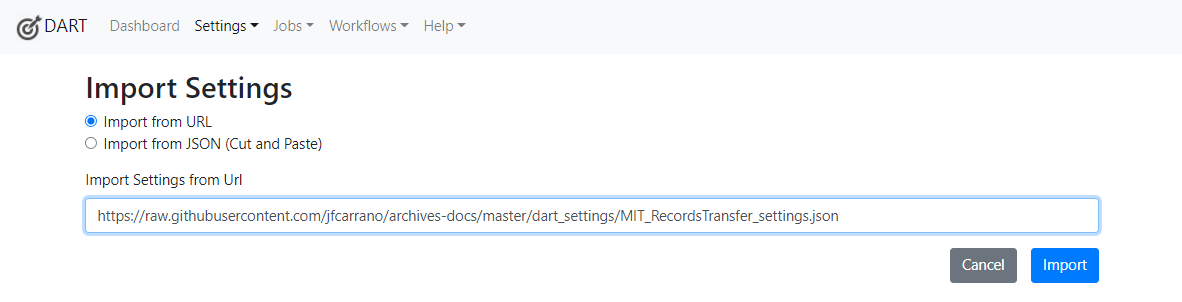
- Click Import
The settings import will show if it is successful on screen. You will also now have a few questions to answer to create presets for your transfers.
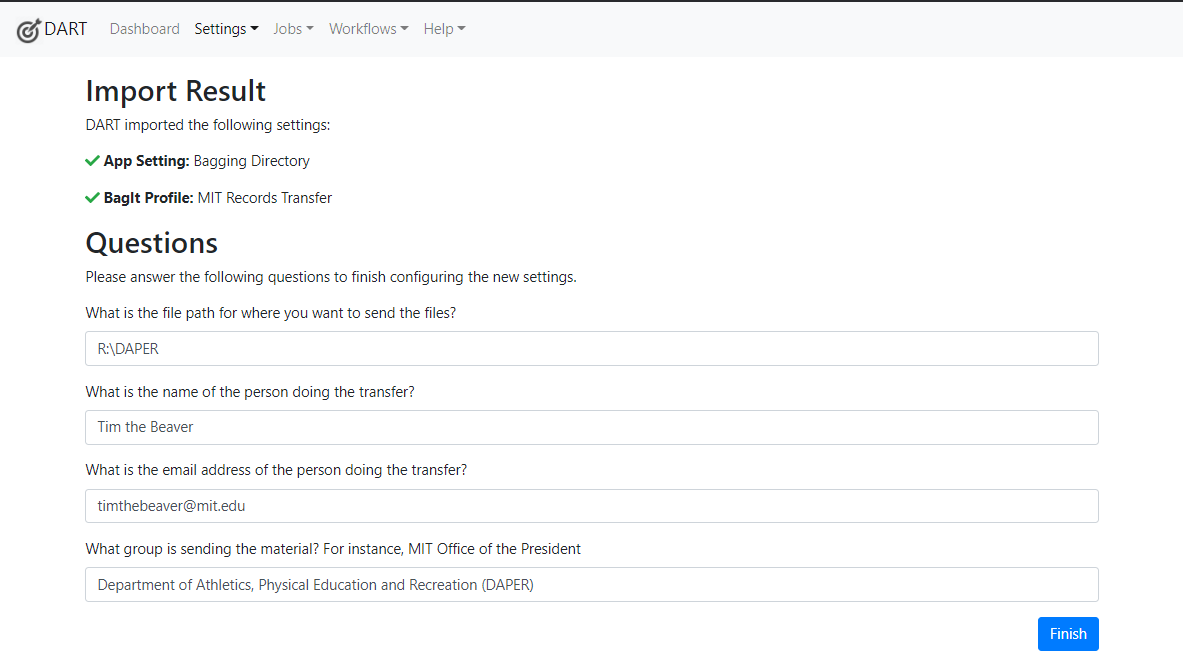
- For the file output path question, enter the file path to your group's folder on the Distinctive Collections records transfer drive (mentioned above in Connect to the network drive, step 2). The end result will be similar to the image below, for example if the records are from DAPERIt will look like what is entered in the screenshot above. The example points to the DAPER folder, it would be on Windows: R:\DAPER (or whatever drive letter was chosen by you at set up) or on Macs: /Volumes/recordscdps-transfer/DAPER.
Click Finish (confirm this)
- recordstransfer/DAPER.
If you're unsure on how to find the file path, try these options:- On Windows:
- go to your file explorer window and navigate into your group's folder in the Distinctive Collections records transfer drive (cdps-recordstransfer).
- Click on the address bar at the top of the window and copy the file path.
- Now that you have the path copied, paste it into the file path question in DART.
- On Mac:
- go to your Finder window and navigate to the Distinctive Collections records transfer drive (cdps-recordstransfer).
- Control click on your group's subfolder.
- When the menu pops up, hold down the Option button on your keyboard.
- Instead of regular “Copy” you will now see “Copy "[your group's subfolder]" as Pathname”, click that.
- Now that you have the path copied, paste it into the file path question in DART.
- On Windows:
- Fill out the other questions with your name, email address, and group's name.
Click Finish
You Once complete, you should now be ready to start using DART for records transfers. Proceed to the Using DART section.
Using DART
Go To transfer records, open DART and go to Jobs > New.
Drag and drop any folders or files you want to transfer onto the blue-dotted line box in the DART window. When ready click Next >>.
- Leave Package Format as is.
Under BagIt Profile, select the "MIT records transfer" profile Records Transfer" profile (this option was imported during the set up above).
For Serialization, select ".tar".
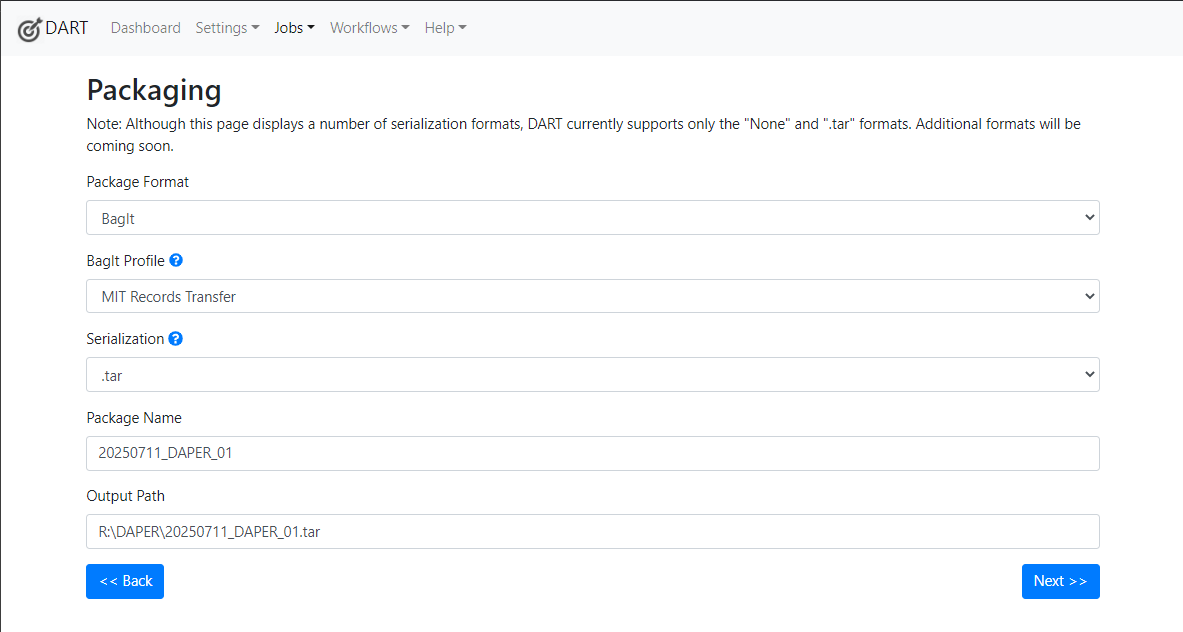
Package Name should be as follows: the present date in YYYYMMDD format followed by _TheNameofYourOffice_01, for instance 20201109_OfficeOfThePresident_01 or 20250711_DAPER_01. This will be the name of the package produced in the new location.
- If you have multiple transfers to complete in the same day, increase the ending number by one for each additional transfer after the first one for that date. For instance the second transfer from the first example would be, 20201109_OfficeOfThePresident_02, etc.
Output path is the location where the files will be going to. This should is already be preset by default when you set from setting up DART. The tool will automatically insert the package name you entered above.
Click Next >>
Enter or adjust any description related to the transfertransfer (Bag Metadata) following the help text (hover over the "?" symbol to see this the help text for each field).
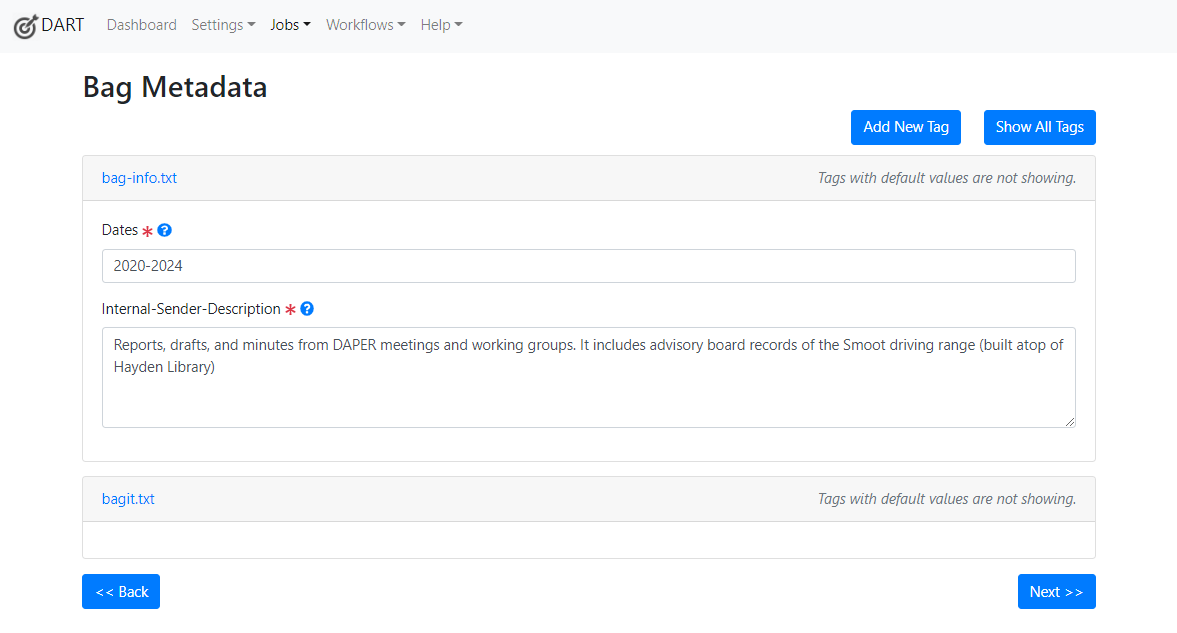
Click Next >>
The Upload Targets page should be blank, this is only used when sending content to a cloud service, Click Next >>
On the next page, review the job, you can go back if you .
If you need to adjust something
click Back>>
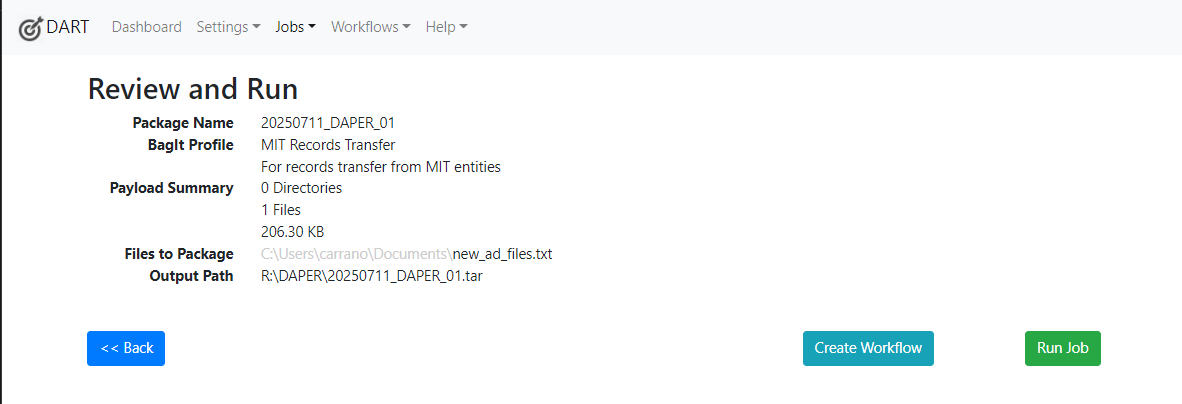
If everything looks good, click the "Run Job" button
The progress screen will show when the package is created and validated.
If it fails, you can try
again or
contact Distinctive Collections.
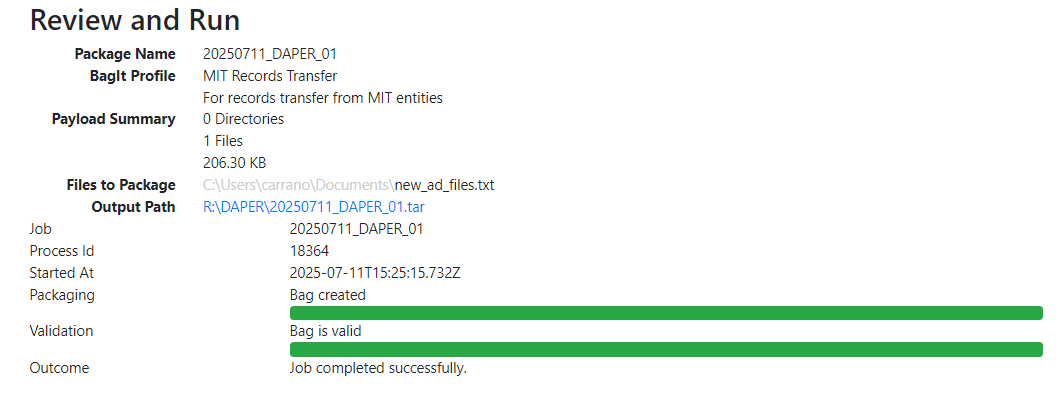
- If successful, please contact Distinctive Collections to confirm you've completed your transfer.
- If you have additional transfers to make, return to step 1. If not, you are all done.
Please do NOT delete your original files until after you have received a notification from Distinctive Collections that we have successfully added confirming receipt of proper transfer of the files to your department’s collection. This may take several weeks.
Warning Note: you cannot alter or add any files to the package after it has been transferred. If you need to do so, you will have to redo the transfer, please contact Distinctive Collections staff if that is necessary.
...