...
We are two graduate students from MIT and we would like to share our experiences in carrying out the General Circulation Experiment in our GFD laboratory here.
The Experimental Set-up is described on a separate page. Please visit Experimental Setup for General Circulation Experiment (Wilken & Julian)
Introduction
It is a well-established observation that there is more solar incoming radiation at the equator than at the poles and that the radiative heat loss at the poles is much stronger than at the equator. In order to keep a steady state system, there needs to be meridional, i.e. poleward, heat transport in the earth system. Both the atmosphere and the ocean contribute to this, but the mechanisms are quite different depending on the Rossby radius of deformation compared to the geometrical size of the domain in which the transport occurs. The reason is that motion initially is directed in one direction, but that the Coriolis force deviates this motion to the right in the Northern Hemisphere (left in the Southern Hemisphere).
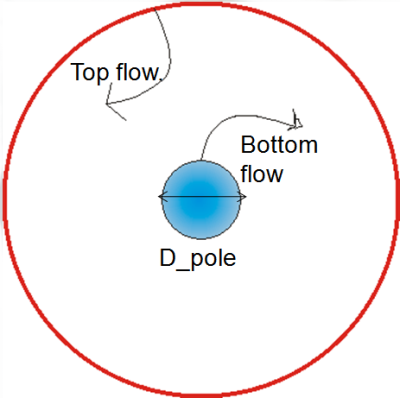
The temperature forcing wants to bring warm water inwards in our experiment (warm air/water polewards in the real atmosphere/ocean) and cold water outwards (equatorwards). For low rotation rates (small f), the Rossby radius is much smaller larger than the circumference of our tank (a latitudinal circle in the atmosphere). In this case, the circulation is symmetric with respect to the pole and cold fluid flows inward on the bottom and gets deflected to the right resulting in anti-cyclonic motion. Warm fluid moves outward on the top, gets deflected to the right and results in anti- cyclonic motion. This circulation is analogous to the Hadley circulation in the low latitude atmosphere. A sketch of the deviation of the moving fluids can be seen in the following sketch:
...
You can find our experimental setup description here: Experimental Setup for General Circulation - Experiment Tips(Wilken & Julian)
Hadley Regime f=0.1s^-1
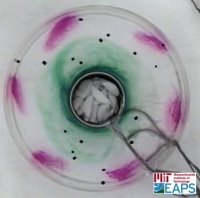
We have used a rotation rate of f=0.1s^-1. Here we present a top view onto our experiment. Turn on your computer's volume as we have commented the video!
 http://www.youtube.com/watch?v=olKFj6g-nPw&feature=channel&fmt=18
...