Before proceeding ask yourself: is a hand calculation not sufficient for this task?
It's important to remember that CFD is a model of the real flow physics. We look to capture the physics such that we arrived at a "good answer" – one that is close to reality. What does this mean? Two things: First, we generally don't need to model the flow disruption of every bolt hole and scratch. Second, it's important to know how right your answer needs to be. Within 10% of reality? You may spend significant time running thousands of iterations and performing mesh sensitivity studies. For Rocket Team purposes, this level of accuracy has (to date) never been needed. In January 2026, Rocket Team demonstrated roll stability on a subsonic rocket (see: Xanthus) with aero surfaces that ended up having a modelling error of 250 percent! In other words, we overpredicted aero forces on the control surfaces by 2.5x!
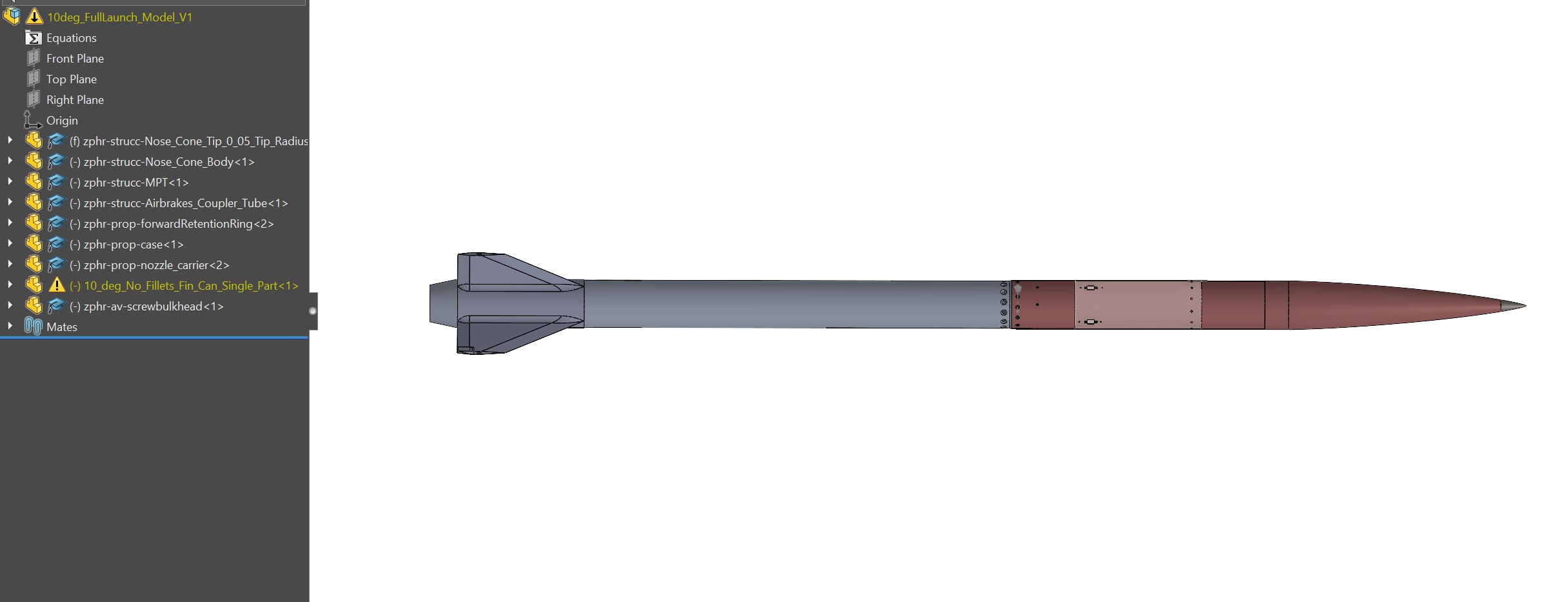
How is this relevant to the CFD process? We will delete unnecessary features in our model to help keep the CFD solver stable and speed up solver convergence.
Steps:
Save CAD assembly As a new .SLDPRT file (you can save assemblies as parts!)

Defeature the model using the "Delete Face" and "Delete Body" tools. Your judgement is required to determine what's important.