- CADed a chassis for the payload
- 7.5x7x8' Cube-ish
- 2 layers split by a divider plate
- Balloon's 4 point harness attached to base plate, no top plate. Initially planned on mounting to a roof fixture, but changed to floor fixture because: a) it'd be redundant to have both a roof for the chassis and a roof of foam, and b) it'd make it hard to move things around and physically insert things with a roof in the way.
- Foam was made out of insulation foam board, selected at 3/4" to protect the sensors.
Improvements to be made
- Fix up timing next time and make sure to properly train everyone in CADing so a last minute grind doesn't need to be done again, and so that we have time to test, and play around with the physical model prior to launch
- Get a better visual idea of how to budget space (i.e. allocating better clearance)
- Account for battery drain during setup
- Determine heat emitted of active components
- Important Factors
- Dedicating enough space and surface area for all components. This determined the size of the cube and how many layers
- The size of the biggest components, including the spectrometer and the muon detector; primary determiners in layout and setup
- Weight - comply with regulations, minimize the size of spectrometer as it was being designed and built. We considered changing the
- Weight distribution - minimize spin as HAB ascended
- Screw embedment length - impacted our decision for wall thickness
- Thermodynamic regulation - foam was used to insulate the payload from high altitude temperatures. We concluded thermal emission from batteries weren't a problem.
- NOTE for later - Why were the batteries' thermal emissions not a problem anymore
- Sensor Accessibility - some components needed to have access to the outside. The Go-Pro was integrated completely outside of the box. The spectrometer was part inside so sensitive electronics could be safe, and we led a fiber optic cable to the outside of the chassis by cutting a tiny hole in the foam.
- Other Ideas
- Cut Foam for temperature insulation
- Everything was measured precisely and cut out in accordance
HAB Chassis Design Report
Task: Design a chassis for a high-altitude balloon test. The design must protect the interior components from temperature fluctuations and environmental exposure. Some sensors had their own individual requirements when implemented in the chassis:
- The spectrometer's sensor must be exposed through one of the sides of the chassis, pointing upwards exposed to the sun.
- The Go-Pro must be secured on the outside of the chassis, pointed to the horizon.
- The second live camera must be exposed through one of the sides, pointing just under the horizon.
Additionally, the chassis must not exceed a total weight of 6 lbs (excluding the balloon) due to §101.1(a)(4)(ii) (Hard Limit 6 lbs/package - Hard per-package weight cap)
Interior Design: The chassis was inspired by the public-source CubeSat design: Universal 1U Cubesat by Juliano85 - Thingiverse and 3D printed with PETG. PETG was chosen over other potential materials such as PLA because PETG was stiff, durable, and light. The interior space of the design was 7.5x8x7' mostly because of the spectrometer, whose dimensions was 6.3x4.3x3.5'.
The following sensors were put into the playload:
The structure would have two floors with the spectrometer and secondary camera on the bottom floor and the Argus Board, battery, and miscellaneous (temperature, pressure) sensors on the second floor. The miscellaneous sensors and two batteries were fastened with zip ties to fix them to the structure. The top of the chassis was originally planned but then omitted from the final design due to weight constraints. To remove the top chassis, the bottom chassis had drilled holes to fasten the eye bolts connected to the balloon.
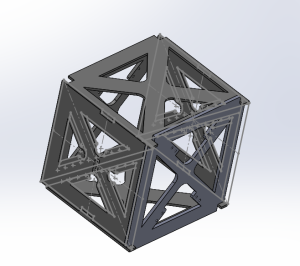
Figure 1: CAD of HAB Chassis
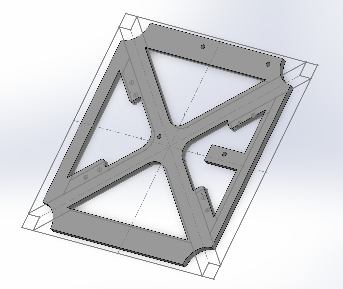
Figure 2: CAD of second floor. Corners were rounded and sanded so that the strings of the balloon could be attached through the floor.
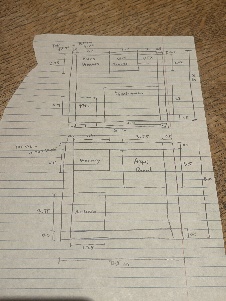
Figure 3: Sketch of how the sensors were organized inside the chassis. Ultimately discarded due to time constraints.
At the time of launch, there was not enough helium in the balloon to lift the payload. The VTX and second battery were removed as a result.