Coherence is broadly the ability for light to constructively/destructively interfere with itself.
Suppose we have a point in space denoted P, where two incident plane waves originating from sources S1 and S2 intersect.
We denote the total electric field intensity at this point as .
Therefore, we say that the total intensity at that point is
Expanding this out, we have
I=\langle(\vec E_1+\vec E_2)\cdot (\vec E_1^*+\vec E_2^*)\rangle=\langle |E_1|^2 + |E_2|^2+ 2\text{Re}(E_1\cdot E_2^*)\rangle = I_1+I_2+2\text{Re}\langle E_1E_2^*\rangle |
Evidently, the total intensity is the sum of the two intensities, plus a cross term. This is the "interference" term.
When no interference occurs, we say that the two beams are mutually incoherent.
We can now try to quantify this notion of coherence a bit more by focusing on the interference term.
Suppose that the two
There are two notions of coherence: Spatial and Temporal.
Temporal coherence asks: if I take a single point in space and look at the magnitude of the E field at t=0, do I have any information about what the E field will be at some later time t=tau? ie, does the E field at that point in space have a steady phase over time?
Spatial coherence asks: if I take two separate points in space, does knowing the E field at one point give any information about the E field at another point? ie, do two spatially separate points have the same phase relationship?
Spatial coherence has two aspects: transverse and longitudinal. this is only based off what your choice of those two points are.
We've already discussed transverse spatial coherence. This is what people typically mean when they say "spatial coherence". Essentially we ask how correlated the E field is between two points that are transverse to the direction of propogation.
Longitudinal spatial coherence asks how correlated the E field is between two points along the same direction of propogation. This is essentially just set by the coherence length of the source, which is actually determined by the coherence time of the source and thus is highly related to temporal coherence. For two points that are closer together than the coherence length (c*t_coherence), the E fields are highly correlated. For two points further than the coherence length, the E fields have no correlation.
Suppose we have some extended source emitting light and we have two downstream points P1 (fixed) and P2 (variable) being illuminated.
The mutual degree of coherence between these two points is equivalent to the intensity in the following scenario
A spherical wave converges to P1, passing through an aperture of the same shape and size as the extended source. it diffracts, and we find the complex amplitude at point P2.
Consider the case where the distance to the source is very large compared to the source size. Also assume we have a circular source.
This allows us to approximate the incoming spherical wave as a plane wave. We further approximate that the plane wave has normal incidence.
Then, the mutual degree of coherence between the central point P1 (lying at the 0th order diffraction maxima) and the off axis point P2,
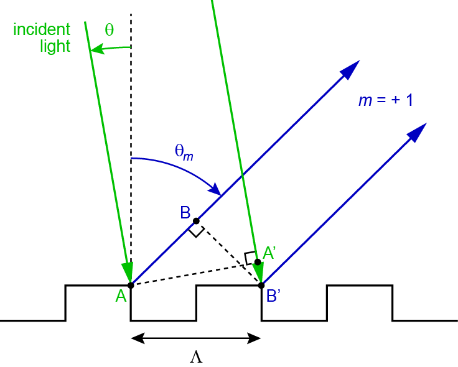
This schematic here depicts incident light hitting a reflective grating
At the grating, we want the incident wavefront to have a transverse spatial coherence equal to or larger than the grating width because this maximizes the number of lines that are illuminated with spatially coherent light. This gives us the maximum spectral resolution since it makes the peaks sharper.
Suppose we have a grating of width 12.7mm. The total distance from the grating to the slit is about 95.4mm.
Suppose the slit is a circular aperture. What is the minimum slit size needed to