Contributors: Kareena, Angelina
QC Missions:
- Demonstrate and validate quantum communication capabilities in-space
- Develop secure communication networks using QKD (quantum key distribution)
- Contribute towards the development of long-range in-space communication
Moving towards:
- Constellation of satellites for long-range in-space communication → potential inter-collegiate collaboration
Instruments/sensors:
Quantum Payload Instrumentation
- BB84/Decoy-State QKD Source
- Laser Diodes
- Intensity Modulator
- Phase or Polarization Modulator
- Polarization-Maintaining Fiber Components or Bulk Optics
- Bean Expander/Telescope
- Entangled Photon Source (SPDC Source)
- Pump Laser
- Nonlinear Crystal
- Temp Control Module
- Beam-Splitting and Filtering Optics
Optical Link/Acquisition and Tracking Instrumentation
- Optical Terminal
- Primary Aperture/Telescope
- Fine Steering Mirror
- Coarse Pointing mechanism
- Beacon System
- Classical Beacon Laser
- Photodiode or Position-Sensitive Detector
- Dedicated Star Tracker
Ground Segment Instrumentation
- Ground Optical Terminal
- Large Aperture Telescope
- Adaptive Optics
- Single-Photon Detectors
- Beacon Lasers
- High-Speed Classical Downlink Receiver
- Timing Equipment
- GPSDO
- Rubidium or Cesium Atomic Clock
- High-Speed Time-Taggers
Cost Analysis:
Quantum Payload ($200k - $650k)
- Photon Source (BB84 or decoy-state) - ($80k - $200k)
- SPDC Entangled Source - ($150k - $350k)
- Nonlinear crystal + Temp Control - ($20k - $60k)
- Quantum Optics Bench - ($30k - $120k)
- Single-Photon Detectors - ($40k - $120k)
- Time Tagging Electronics - ($10k - $50k)
- Optical Filtering/Fiber Coupling - ($10k - $50k)
*This is not necessarily accurate, we need to look into this project more (might be on the higher end)
QUARC: Quantum Research Cubesat—A Constellation for Quantum Communication
https://arxiv.org/abs/1704.08707
Size Analysis:
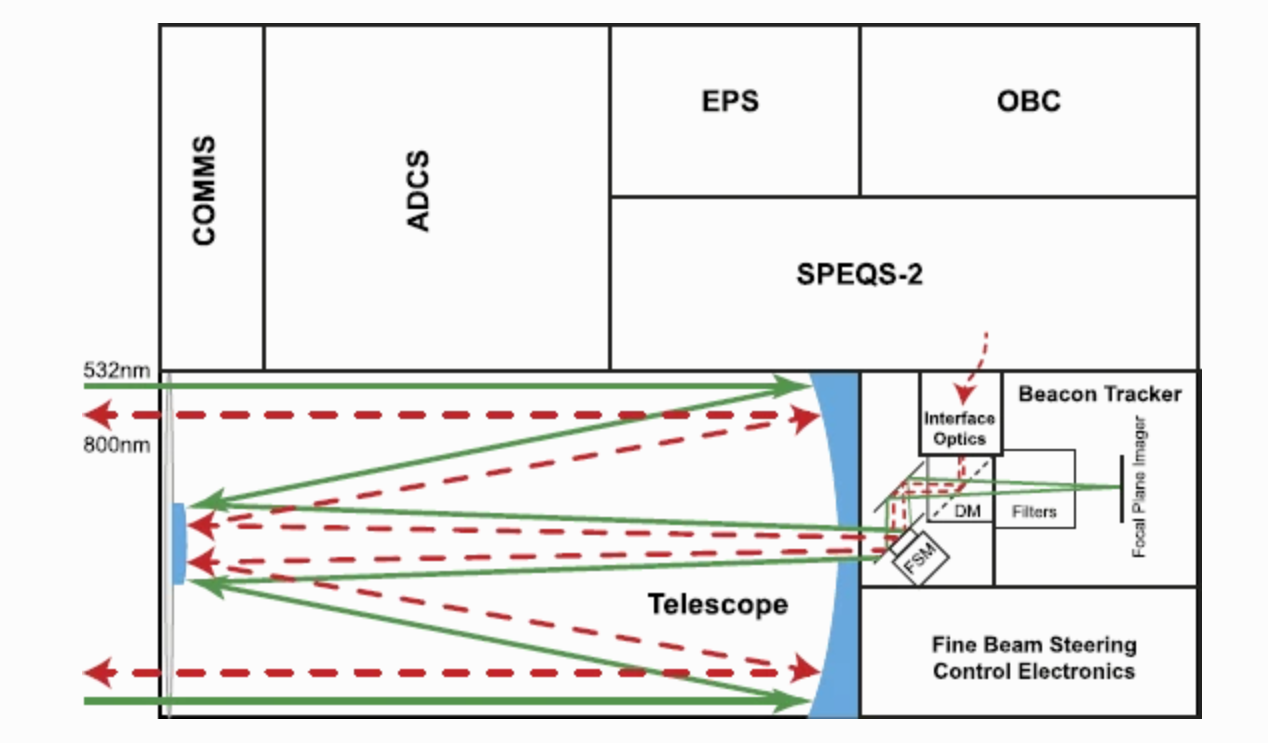
6U cubesat, nominal 12cm x 24 cm x 36cm (based on 1) → weighs 10kg
- 2U allocated to electrical power system (EPS), communications (COMMS), attitude determination and control systems (ADCS), and an on-board computer (OBC)
- 1U for quantum source
- 3U for transmission optics
Payload Compatibility:
| Feature | 6U Cubesat |
|---|---|
| Payload Volume | 1U (quantum source parts) |
| Mass Budget | SPEQS-2 (entangled photon source) 500 g |
| Power Budget | orbit averaged power 11 W assuming 80% sun-tracking efficiency |
| Instrument Performance | --- |
| Data downlink | X-band CubeSat transmitters provide up to 100 Mb/s data rate |
Reasons to pursue:
Current space communication systems are fiber-based and only offer short-range communications. While there are optical/laser communication alternatives they are constrained by limited sightlines. Also, with the rise of critical and valuable data transmissions, there is a need for secure, and safe communication systems which will be enabled by QKD (quantum key distribution) in these quantum communication networks. Through this mission, we will be able to validate long-range communication networks that are also secure and efficient for future applications.
Cubesats offer the possibility of validating such a technology with quicker, more efficient turnaround times
Resources: