Basic Specifications
Wavelength range: 200-500nm
Center wavelength: 350nm
Optical Configuration: Crossed Czerny Turner
Grating size: 12.7mm x 12.7mm
Grating lines/mm: 600 grooves per mm
Image Sensor: Hamamatsu Photonics S3903-Q1024
Pixel Array: 20μm x 0.5mm, 1024 pixels in total. Pixels are spaced 25μm apart, so a 5μm gap between adjacent pixels
Collimating mirror focal length: 50mm
Focusing mirror focal length: 75mm
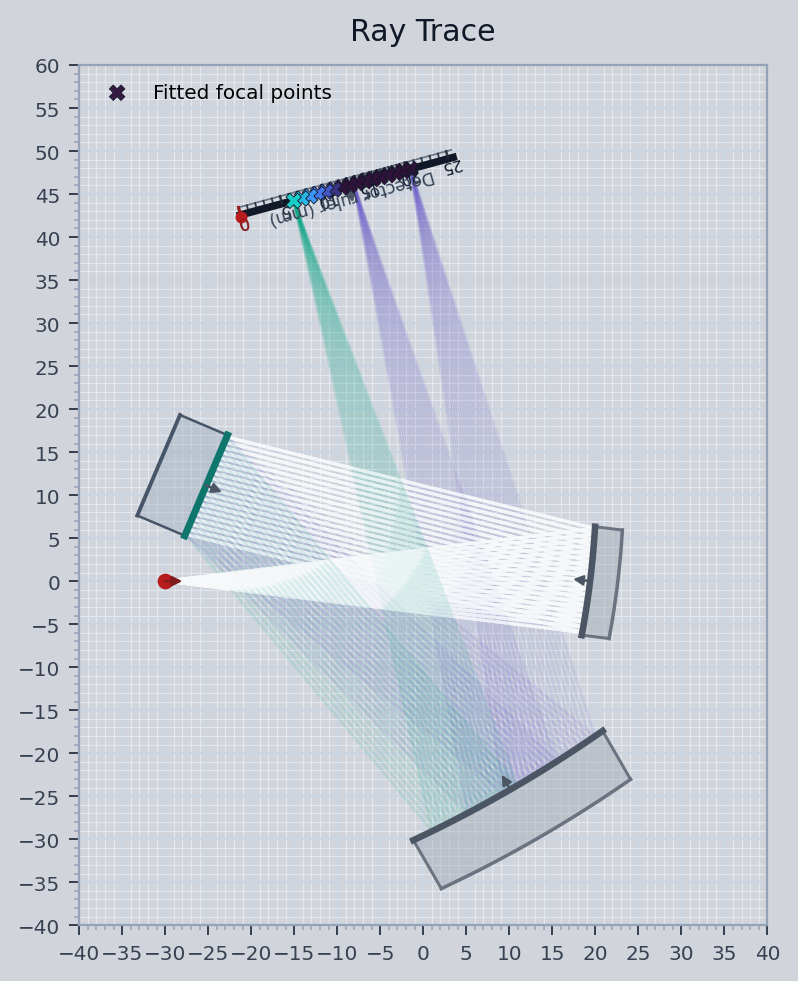
Resolution Calculations
There are multiple contributing factors to the resolution of the spectrometer.
Slit image width
The spectrometer accepts a fiber input which has a core diameter of 105μm. This forms the "slit" of the spectrometer.
The image of this slit is projected onto the image sensor with some magnification given by:
| M=\frac{l_F}{l_C} |
For this spectrometer, l_F is 75mm and l_C is 50mm, giving M=1.5.
This means that the slit image on the detector is 1.5*105μm = 157.5μm.
Pixels are spaced 25μm apart, so this means that the slit is exposed to about 6.3 pixels.
Optimal slit width
This is a bit large, so we can actually improve it by making the slit smaller.
First, we put a small slit in front of the fiber optic. If we press the slit tightly against the entrance of the fiber, then the resulting pattern of light that comes out follows a frauenhofer diffraction pattern.
Suppose we use a circular aperture of width w. The collimating mirror is 50mm away, and is 12.7mm in diameter. This means that the angle between the diffraction central peak and the first minimum is about arctan(12.7/2 / 50).
This gives an angle of 0.13 rad. We need to size the slit to produce a diffraction pattern with this angle to the first minimum.
| \phi=1.22\frac{\lambda}{w} |
Given phi=0.13rad, lambda=350nm, then w=3.39μm.
The optimal slit width is thus about 3.39μm.
Then, the slit image width is about 1.5*3.39μm=5.1μm, which is less than a pixel. Thats honestly not great since that means some wavelengths will be entirely undetectable since they land on the deadzone between pixels.
Instead if we try to size the slit such that the projected image covers at least 2 pixels (about 50um), then that means we need a slit of around 33um.
- Making the slit smaller than this actually harms our resolution because we end up focusing to a point smaller than a single pixel, so we miss some wavelengths as they land on dead zones.
Also, im honestly not sure what kind of diffraction pattern we'd see if we shine light from a fiber into a slit. I think it wont exactly be the frauenhofer pattern because that calculation assumes a flat planar wave incident on a slit but the light coming out of a fiber is not a plane wave but rather divergent. I think that given the small size of the slit, the incident waves are effectively planar though since the slit subtends such a small angle over the fiber output.
Also we should consider that a smaller slit cuts down the light throughput into the spectrometer significantly which causes acquisition time to increase.
Diffraction limited spot size
There is a fundamental diffraction limit to how small you can focus a beam of light. This is relevant because you can imagine shinining monochromatic light of maybe 350nm into the entrance of the spectrometer and then asking yourself how large the resulting spot size on the image sensor is.
Light first enters the system via an optic fiber with a NA=0.22. With our 1/2" collimating mirror with a focal length of 50mm, this results in the mirror being overfilled, and thus the collimating mirror acts as an effective aperture for the entire system.
Now when this light hits the focusing mirror, it has to get focused down to a spot. Roughly speaking, the minimum diameter of this spot is given by
| D_{min}=2\times1.22\frac{\lambda l_F}{D_C} |
For the spectrometer, lambda=350nm, l_F=75mm, D_C=12.7mm. This gives a diffraction spot size of about 5μm.
For those who are curious about the physics behind this formula, the next section covers that
First of all, what defines the diameter of a "spot"? Well when light passes through an aperture, it ends up picking up a diffraction pattern. For a circular aperture, the diffraction pattern you observe is called the airy disk.

Essentially a set of concentric rings of decreasing brightness. This is what the focused spot will actually look like.
We say that the diameter of this spot is the diameter of the first minimum, ie where the light goes completely dark for the first time.
Take a look at the diagram below
When you look at the amplitude of a given point which is "y" above the central axis, it recieves light from every point on the aperture. However, each point on the aperture has its own distance to the point on the image plane, which we will call "r".
The overall amplitude of that point is thus the sum of the amplitudes contributed from each point on the aperture. We can express this as an integral over the area of the aperture
| $U(y)=\int_0^R{\int_0^{2\pi}e^{-i\phi}rd\theta}dr$ |
The phase at the detector is given by
| \phi=kr=\frac{2\pi}{\lambda l_F}yz |
Points on the aperture are given in polar coordinates (r,theta).
z is the y distance of a point on the aperture, so its given by z=rcostheta
If you're curious where the phase formula comes from, its from the distance between the point y, and a point on the aperture. Then take a taylor expansion of that and drop the constant l_F.
Overall
| U(y)=\int_0^R{\int_0^{2\pi}e^{-i\frac{2\pi}{\lambda}\frac{y}{l_F}r\cos(\theta)}}dr |
The inner integral evaluates to the first bessel function J0
| U(y)=\int_0^R2\pi J_0(\frac{2\pi y}{\lambda l_F}r)rdr |
The outer integral evaluates to the second bessel function J1
| U(y)=\frac{2\pi R}{\frac{2\pi y}{\lambda l_F}}J_1(\frac{2\pi y}{\lambda l_F}R) |
Anyways all that matters is that the amplitude is zero when we hit the first zero of the Bessel function J1. This happens when
| \frac{2\pi y}{\lambda l_F}R=3.8317 |
| \frac{ yD}{\lambda l_F}=\frac{3.8317}{\pi}=1.22 |
| y=1.22\frac{\lambda l_F}{D} |
In this case, y is the radius of the spot. We multiply it by two to get the full diameter of the spot.
Plugging in lambda=350nm, l_F=75mm, D=12.7mm, we get a spot diameter of 5μm.
Grating Resolution
The focusing mirror maps angular displacements to linear displacements. The angular displacements come from the grating mapping different wavelengths to different angles.
If light hits the mirror at an angle theta, it gets mapped to a linear displacement y via:
| y=\theta l_F |
The grating equation is
| n\lambda=d(\sin\theta_i+\sin\theta_d) |
Differentiate theta_d with respect to lambda, holding theta_i constant.
| n=d\cos\theta_d \frac{d\theta_d}{d\lambda} |
| \frac{d\theta_d}{d\lambda}=\frac{n}{d\cos\theta_d} |
define groove density G=1/d, and n=1
| \frac{d\theta_d}{d\lambda}=\frac{G}{\cos\theta_d} |
Convert this to a linear dispersion using the mirror's equation
| \frac{dy}{d\lambda}=\frac{Gl_F}{\cos\theta_d} |
We can find theta_d from the grating equation.
| \theta_d=\sin^{-1}(\frac{n\lambda}{d}-\sin\theta_i) |
Again, G=1/d, so
| \theta_d=\sin^{-1}(nG\lambda-\sin\theta_i) |
Let n=1, \lambda=350, G=600 grooves/mm, theta_i = 9 degrees
This gives a theta_d of 0.0536 radians
For the spectrometer, l_F=75mm, G=600 grooves/mm, theta_d=0.0536 radians
We can then calculate the linear dispersion about the center wavelength
calculating this, we have a dispersion
| \frac{dy}{d\lambda}=45\frac{\mu m}{nm} |
Now consider that the geometric resolution limit says that our minimum imaged slit width is around 150μm. The diffraction resolution limit says that the minimum spot diameter is 5μm.
We're clearly geometric spot size limited, not diffraction limited. With a spot diameter of 150μm, the wavelength difference between two adjacent spots corresponds to 150/45 nm = 3nm.
This means that the resolution of the spectrometer is 3nm
If instead we use a 33um slit, then the airy disk spans an angle of