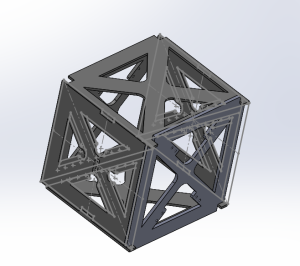
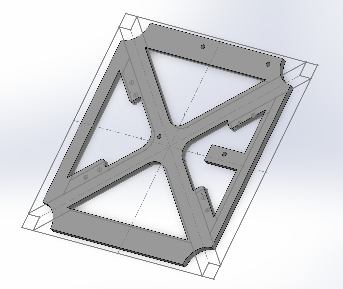
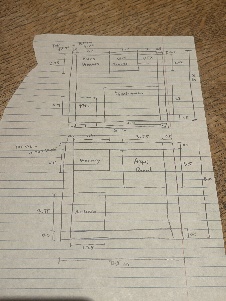
- CADed a chassis for the payload
- 7.5x7x8' Cube-ish
- 2 layers split by a divider plate
- Balloon's 4 point harness attached to base plate, no top plate. Initially planned on mounting to a roof fixture, but changed to floor fixture because: a) it'd be redundant to have both a roof for the chassis and a roof of foam, and b) it'd make it hard to move things around and physically insert things with a roof in the way.
- Foam was made out of insulation foam board, selected at 3/4" to protect the sensors.
- 3/4" was chosen based on this guide for styrofoam: High Altitude Ballooning, From The Ground Up (and back again) – Dave Akerman
...
Additionally, the chassis must not exceed a total weight of 6 lbs (excluding the balloon) due to §101.1(a)(4)(ii) (Hard Limit 6 lbs/package - Hard per-package weight cap)
Interior Design: The chassis was inspired by the public-source CubeSat design: Universal 1U Cubesat by Juliano85 - Thingiverse and 3D printed with PETG. PETG was chosen over other potential materials such as PLA because PETG was stiff, durable, and light. The interior space of the design was 7.5x8x7' mostly because of the spectrometer, whose dimensions was 6.3x4.3x3.5'.
The following sensors were put into the playload:
- SPOT Trace
- Battery
- Altitude/Motion Sensor
- GPS Tracker
- Temperature Sensor
- Pressure/Humidity/Temperature Sensor
- An Airtag
The structure would have two floors with the spectrometer and secondary camera on the bottom floor and the Argus Board, battery, and miscellaneous (temperature, pressure) sensors on the second floor. The miscellaneous sensors and two batteries were fastened with zip ties to fix them to the structure. The top of the chassis was originally planned but then omitted from the final design due to weight constraints. To remove the top chassis, the bottom chassis had drilled holes to fasten the eye bolts connected to the balloon.
Figure 1: CAD of HAB Chassis
Figure 2: CAD of second floor. Corners were rounded and sanded so that the strings of the balloon could be attached through the floor.
Figure 3: Sketch of how the sensors were organized inside the chassis. Ultimately discarded due to time constraints.
At the time of launch, there was not enough helium in the balloon to lift the payload. The VTX and second battery were removed as a result.