...
On Earth, this Coriolis-forced wind movement results in the phenomenon known as the trade winds. Above about the 30th parallel, the conservation of momentum causes a breakdown in the regime of the Hadley cell, and air sinks. We may observe this in practice by examining the average value of ω, the vertical movement at the air, as averaged over all longitudes.
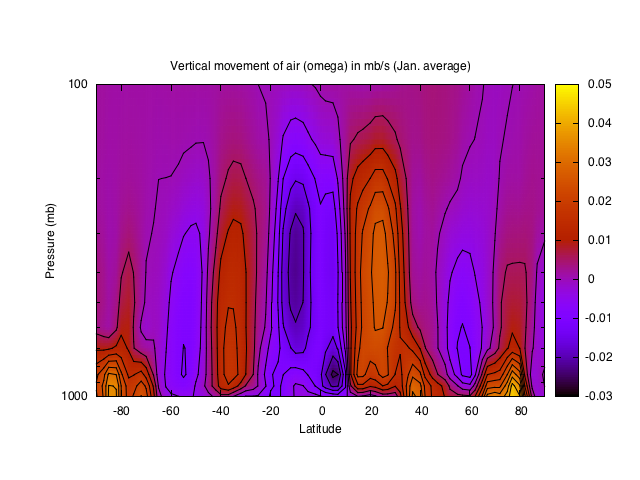
Here, we observe rising air air may be observed to rise close to the equator and sinking sink near 25 degrees north latitude. Since this average is the January average, during winter in the northern hemisphere, the strongest movement is observed in the northern hemisphere, where the temperature gradient is strongest. Similarly, the sinking motion is observed at a lower latitude due to the axis pointing away from the sun. We may also plot the The meridianal movement of the air may also be plotted to demonstrate that this rising and sinking is connected in a single cell.
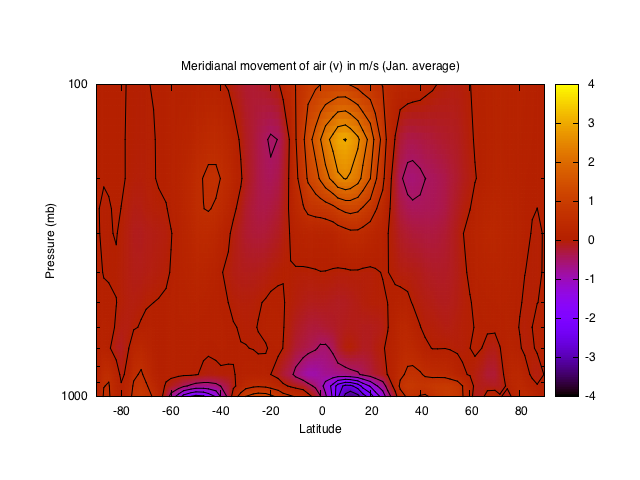
The Hadley cell is visibly completed by the stronger southerly movement of about 3 m/s near the top of the rising column at about the 150mb level, and stronger northerly movement near the surface. The latter movement is the meridianal component of the trade winds.
Tank
...tank...