...
In response to heuristic evaluations, we also added a smaller, condensed version of the steps list to the side of the page, which also appears on each individual step's page as well. With this, users can jump to any step without returning to this instructions overview page. This mini-navigation section is usually collapsed but can be opened if the user needs it, so that even for a project that has a large number of steps, it will not clutter up the page with excess noise.

Another comment from the heuristic evaluations was that there should be a way for the user to return to the step that they left off on. We added this feature to our final design. If the user is logged in, they can keep track of currently active and completed projects. This is visible on the user's dashboard. By clicking on the project in the dashboard, they can jump to where they left off. When a user completes a step, they can quickly check it off before moving to the next step. This features are meant to increase efficiency for users, but because they are not fundamental to our purpose of helping beginners to sewing, we decided that a user could choose not to create an account and log in. In that case, they can still freely access the project tutorials, but their progress will not be tracked.

If a new user is unfamiliar with a particular technique or is likely to need help in some area while on a particular step, they can click on the glossary/sewing basic terms that are linked on each page. A dialog box will pop up that contains explanations, definitions, or suggestions and a relevant video link. We decided to use a dialog box because it is much more efficient for users to find the information they need without having to navigate to a new page (or tab) and back again.
The Sewing Basics section of the site functions as an index of all of the glossary/help entries. If a user wishes, for example, to look up how to do the running stitch, they can do so directly from the Sewing Basics section of the site without having to navigate to a project tutorial step that contains a reference to the running stitch. The dialog box that appears is the same for both methods of looking the term up, however.
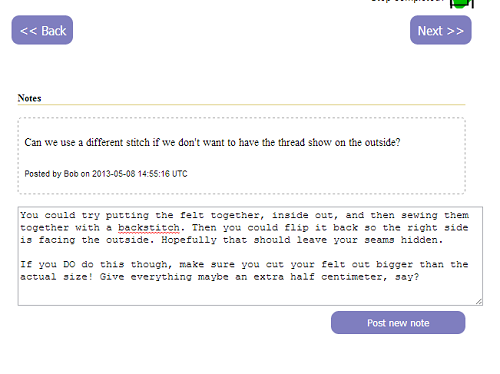
The final major component of our design is the ability to allow users to add notes to the tutorial pages. This is to address the user task of "catching and correcting mistakes made while sewing". There is no optimal way to do this, of course, so we went through a series of ideas before we finally settled on this one. Our paper prototype contained the ambitious and overly optimistic idea of organizing videochats for users based around a specific project, allowing them to help each other catch and correct mistakes as they sew. We found that these "video sew-alongs" were not intuitive for users and veered too far from our initial goal of helping users learn to sew through a project. For our computer prototype, we toyed with the idea of letting users create chatrooms called "Lounges" (as an analogy for real-world sewing lounges). However, for our final implementation, we decided against this for two reasons: 1. implementation would be too difficult given our time constraints and the lesser importance of this feature, and 2. chatting (as opposed to video/voice chatting) requires too much typing than is really practical for someone who is sewing.
...