Coherence
In general coherence Coherence is the same thing as correlation, but applied to electromagnetic waves.
First lets start with what coherence/correlation is.
broadly the ability for light to constructively/destructively interfere with itself.
Suppose we have a point in space denoted P, where two incident plane waves originating from sources S1 and S2 intersect.
We denote the total electric field intensity at this point as
| LaTeX Math Inline | ||
|---|---|---|
|
Therefore, we say that the total intensity at that point is
| LaTeX Math Inline | ||
|---|---|---|
|
Expanding this out, we have Lets say that we have two sources S1 and S2 emitting EM waves, and they combine at some point P.The intensity at this point is thus
| LaTeX Math Block | ||||
|---|---|---|---|---|
| ||||
I=<E\langle(\cdot E^*>=<(vec E_1+\vec E_2)\cdot (\vec E_1^*+\vec E_2^*)> =<\rangle=\langle |E_1|^2 + |E_2|^2+2Re 2\text{Re}(E_1\cdot E_2^*)> |
Where <> denotes a time average defined as
)\rangle = I_1+I_2+2\text{Re}\langle E_1E_2^*\rangle |
Evidently, the total intensity is the sum of the two intensities, plus a cross term. This is the "interference" term.
When no interference occurs, we say that the two beams are mutually incoherent.
We can now try to quantify this notion of coherence a bit more by focusing on the interference term.
Suppose that the two
There are two notions of coherence: Spatial and Temporal.
Temporal coherence asks: if I take a single point in space and look at the magnitude of the E field at t=0, do I have any information about what the E field will be at some later time t=tau? ie, does the E field at that point in space have a steady phase over time?
Spatial coherence asks: if I take two separate points in space, does knowing the E field at one point give any information about the E field at another point? ie, do two spatially separate points have the same phase relationship?
- Suppose we have a single point source S, which emits perfect monochromatic light with a random phase in short random bursts of time. This source is thus highly temporally incoherent because you check the E field at one point in time (where it is emitting perfect monochromatic light with a constant phase but for a very short amount of time), and then when you wait a bit of time the source has already changed up what phase it emits with so then you now have no idea what the E field at time t+tau will be.
- However, this source is still perfectly spatially coherent! At any point in time, you measure the E field at two transverse points (points that are the same distance from S). because its a single point source, you know they must have the exact same E field!
Spatial coherence has two aspects: transverse and longitudinal. this is only based off what your choice of those two points are.
We've already discussed transverse spatial coherence. This is what people typically mean when they say "spatial coherence". Essentially we ask how correlated the E field is between two points that are transverse to the direction of propogation.
Longitudinal spatial coherence asks how correlated the E field is between two points along the same direction of propogation. This is essentially just set by the coherence length of the source, which is actually determined by the coherence time of the source and thus is highly related to temporal coherence. For two points that are closer together than the coherence length (c*t_coherence), the E fields are highly correlated. For two points further than the coherence length, the E fields have no correlation.
Van Cittert-Zernike theorem
Suppose we have some extended source emitting light and we have two downstream points P1 (fixed) and P2 (variable) being illuminated.
The mutual degree of coherence between these two points is equivalent to the intensity in the following scenario
A spherical wave converges to P1, passing through an aperture of the same shape and size as the extended source. it diffracts, and we find the complex amplitude at point P2.
Consider the case where the distance to the source is very large compared to the source size. Also assume we have a circular source.
This allows us to approximate the incoming spherical wave as a plane wave. We further approximate that the plane wave has normal incidence.
Then, the mutual degree of coherence between the central point P1 (lying at the 0th order diffraction maxima) and the off axis point P2,
Diffraction Gratings
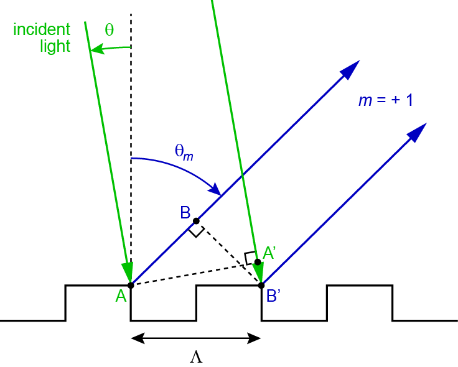
This schematic here depicts incident light hitting a reflective grating
Applied to spectrometer design
At the grating, we want the incident wavefront to have a transverse spatial coherence equal to or larger than the grating width because this maximizes the number of lines that are illuminated with spatially coherent light. This gives us the maximum spectral resolution since it makes the peaks sharper.
Lets try to quantify what we mean by "sharper" here.
Suppose we have a grating with some grating period
| LaTeX Unit | ||
|---|---|---|
|
We also have a monochromatic light source with wavelength
| LaTeX Unit | ||
|---|---|---|
|
| LaTeX Unit | ||
|---|---|---|
|
This means that there is an "incident electric field" on the grating, which we denote
| LaTeX Unit | ||
|---|---|---|
|
We define the mutual intensity J as follows
| LaTeX Unit | ||
|---|---|---|
|
We've seen this before, its just the interference term from earlier, also called the mutual coherence function or correlation function. When this value is high, we have high potential for interference and when it is close to 0 we have essentially no interference.
In the case where x1=x2=x, ie the diagonal, it just reduces to the intensity at x
OK now we take a step back and think from some first principles.
What we observe with a diffraction grating in the far field is essentially the spatial fourier transform of the incident electric field at the grating.
| LaTeX Math Block | ||||
|---|---|---|---|---|
| ||||
<f>E(\theta)=C\limint_{T\rightarrow-\infty}^{+\infty}E_{out}e^{i\frac{2\pi}{\lambda}x\sin\theta}dx |
Where C is a constant prefactor which has the appropriate units. The term in the exponential is essentially the phase difference between a ray at x=0 and a ray at x=x. This is a limiting case of the Fresnel-kirchhof formula.
Anyways, E_out needs to be determined. The grating is essentially a series of opaque and non opaque strips, so we can describe its transmission as
| LaTeX Math Block | ||||
|---|---|---|---|---|
| ||||
t(x) = \begin{cases} 1 & \text{if }{T}\int_0^Tf(t)dt \mod(\lfloor x/\Lambda\rfloor,2)\neq0 \\ 0 & \text{otherwise} \end{cases} |
So lets say E_out(x) = E_in(x)t(x)
| LaTeX Math Block | ||||
|---|---|---|---|---|
| ||||
E(\theta)=C\int_{-\infty}^{+\infty}E_{in}(x)t(x)e^{i\frac{2\pi}{\lambda}x\sin\theta}dx |
The intensity is thereforeThis reduces the intensity down to
| LaTeX Math Block | ||||
|---|---|---|---|---|
| ||||
I=I_1+I_2+2Re<E_1\cdot E_2^*> |
For a typical interference experiment, we take a single source and then route the light through two different paths and then recombine at a point P.
suppose that the light E_2 takes an additional time tau to get to P compared to E_1.
(\theta)=\langle E^*(\theta)E(\theta)\rangle = \langle C^2\int_{-\infty}^{+\infty}E^*_{in}(x_1)t^*(x_1)e^{-i\frac{2\pi}{\lambda}x_1\sin\theta}dx_1 \int_{-\infty}^{+\infty}E_{in}(x_2)t(x_2)e^{i\frac{2\pi}{\lambda}x_2\sin\theta}dx_2\rangle
|
OK lets simplify this. First of all, move all the things that are not time dependent out, and combine the two integrals as they integrate independent quantities.
| LaTeX Math Block | ||||
|---|---|---|---|---|
| ||||
I(\theta)= C^2\int_{-\infty}^{+\infty}\int_{-\infty}^{+\infty} t^*(x_1)t(x_2) \langle E^*_{in}(x_1)E_{in}(x_2)\rangle e^{i\frac{2\pi}{\lambda}(x_2-x_1)\sin\theta} dx_1dx_2 |
OK now notice that the only time dependent term is the E field part, so actually we can simplify the entire thing down using the mutual intensity we found earlierWe define the "mutual coherence function" as follows
| LaTeX Math Block | ||||
|---|---|---|---|---|
| ||||
\Gamma_{12}(\tau)=<E_1(t),E_2^*(t+\tau)> | ||||
I(\theta)= C^2\cdot \int_{-\infty}^{+\infty}\int_{-\infty}^{+\infty}t^*(x_1)t(x_2)\cdot J(x_1,x_2)e^{i\frac{2\pi}{\lambda}(x_2-x_1)\sin\theta} dx_1dx_2 |
OK now lets figure out more details about the mutual coherence J.
First of all, as we've seen before, J is related to the complex degree of coherence as followsAnd then we use this mutual coherence function to repackage the cross term in the intensity
| LaTeX Math Block | ||||
|---|---|---|---|---|
| ||||
I=I_1+I_2+2Re\Gamma_{12}(\tau) |
...
\mu(x_1,x_2)=\frac{J(x_1,x_2)}{\sqrt{I(x_1)I(x_2)}}=\frac{J(x_1,x_2)}{I_0} |
The second step follows from the fact that we assume uniform incident intensity across the grating I_0
Now all we need to do is specify the complex degree of coherence between two points x_1 and x_2 on the grating!
For this, we can utilize whats called the "Gaussian-Schell Model". We know obviously that when x_1=x_2=x, then the complex degree of coherence should be 1 since a point is perfectly coherent to itself (if you know the value of E at x=0, then you know obviously the value of E at x=0)
For typical spatially incoherent sources, there is some typical "transverse spatial coherence width" where points closer than this are roughly spatially coherent and points further away are spatially incoherent.
From this, we create the following model for the complex degree of coherence!
| LaTeX Math Block | ||||
|---|---|---|---|---|
| ||||
\gamma_{12}(\tau)=\frac{\Gamma_{12}(\tau)}{\sqrt{\Gamma_{11}(0)\Gamma_{22}(0)}}=\frac{\Gamma_{12}(\tau)}{\sqrt{I_1I_2} |
where we essentially normalize the mutual coherence function by I1 and I2
mu(x_1,x_2)=e^{-\frac{(x_2-x_1)^2}{2l_c^2}} |
This follows a gaussian distribution and will be our model of spatial coherence across the grating surface.
We now solve for J(x1,x2)!
Anyways, we can now plug it into the equation for I
| LaTeX Math Block | ||||
|---|---|---|---|---|
| ||||
I(\theta)= C^2\cdot \int_{-\infty}^{+\infty}\int_{-\infty}^{+\infty}t^*(x_1)t(x_2)\cdot I_0e^{-\frac{(x_2-x_1)^2}{2l_c^2}} e^{i\frac{2\pi}{\lambda}(x_2-x_1)\sin\theta} dx_1dx_2 |
quite a hairy integral I'll try to simplify it a bit down now
| LaTeX Math Block | ||||
|---|---|---|---|---|
| ||||
I(\theta)= C^2I_0\cdot \int_{-\infty}^{+\infty}\int_{-\infty}^{+\infty}t^*(x_1)t(x_2)\cdot e^{-\frac{\Delta x^2}{2l_c^2}} e^{i\frac{2\pi}{\lambda}\Delta x \sin\theta} dx_1dx_2 |
I'm sure theres a way to solve this explicitly, but I'm not quite that good at math and instead lets just look at the limiting cases and then do numerical simulation in between.
First case is for perfectly spatially coherent light. This means the transverse spatial coherence width is infinite, l_c=infinity, so then J(x1,x2)=I_0We then again update the intensity formula
| LaTeX Math Block | ||||
|---|---|---|---|---|
| ||||
I=I_1+I_2+2\sqrt{I_1I_2}Re\gamma_{12}(\tau) |
Okay so now we know how to find the measured intensity at some point if we have two sources coming in that have travelled different optical path lengths.
It seems that it depends on the value of gamma; let E1=E2=E. When gamma=0, I=2I. when gamma=1, I=4I.
...
(\theta)= C^2I_0\cdot \int_{-\infty}^{+\infty}\int_{-\infty}^{+\infty}t^*(x_1)t(x_2)\cdot e^{i\frac{2\pi}{\lambda}\Delta x \sin\theta} dx_1dx_2 |
| LaTeX Math Block | ||||
|---|---|---|---|---|
| ||||
I(\theta)= C^2I_0\cdot |\int_{\text{slits}}e^{i\frac{2\pi}{\lambda}x \sin\theta} dx|^2 |
blah blah blah some math later (fill in later)
We get the typical formula for perfect spatial coherent diffraction against N slits
We also check the fully incoherent limit, and that pops out that we should get uniform illumination in the far field.
- Is this weird? I don't think so. Diffraction relies on the fact that we have consistent spatial phase relationships between different points, such that we are able to get clear patterns of constructive and destructive interference. If we have perfectly incoherent light, then the E field at one point is entirely random and unpredictable from the E field at another point. This means that upon time average, there are no special spatial relationships between any points which causes us to get zero observable constructive or destructive interference upon time average.
- Despite this, we observe visible diffracted rainbows off common diffraction gratings like CDs using all sorts of lighting from the sun or lightbulbs etc. This isn't necessarily a contradiction because in reality I dont think there are many obvious 100% spatially incoherent sources. From the van-cittert zernike theorem we know that essentially any arbitrary light source will become spatially coherent at enough distance. the sun for example has some spatial coherence at the earths surface. lightbulbs etc when viewed from sufficiently far away have spatial coherence.
OK I had claude solve this integral explictly so not only do we now know the limiting cases, we also analytically know the general solution.
I made a script that shows the resulting angular diffraction pattern for various incident transverse spatial coherence lengths and its shown below.
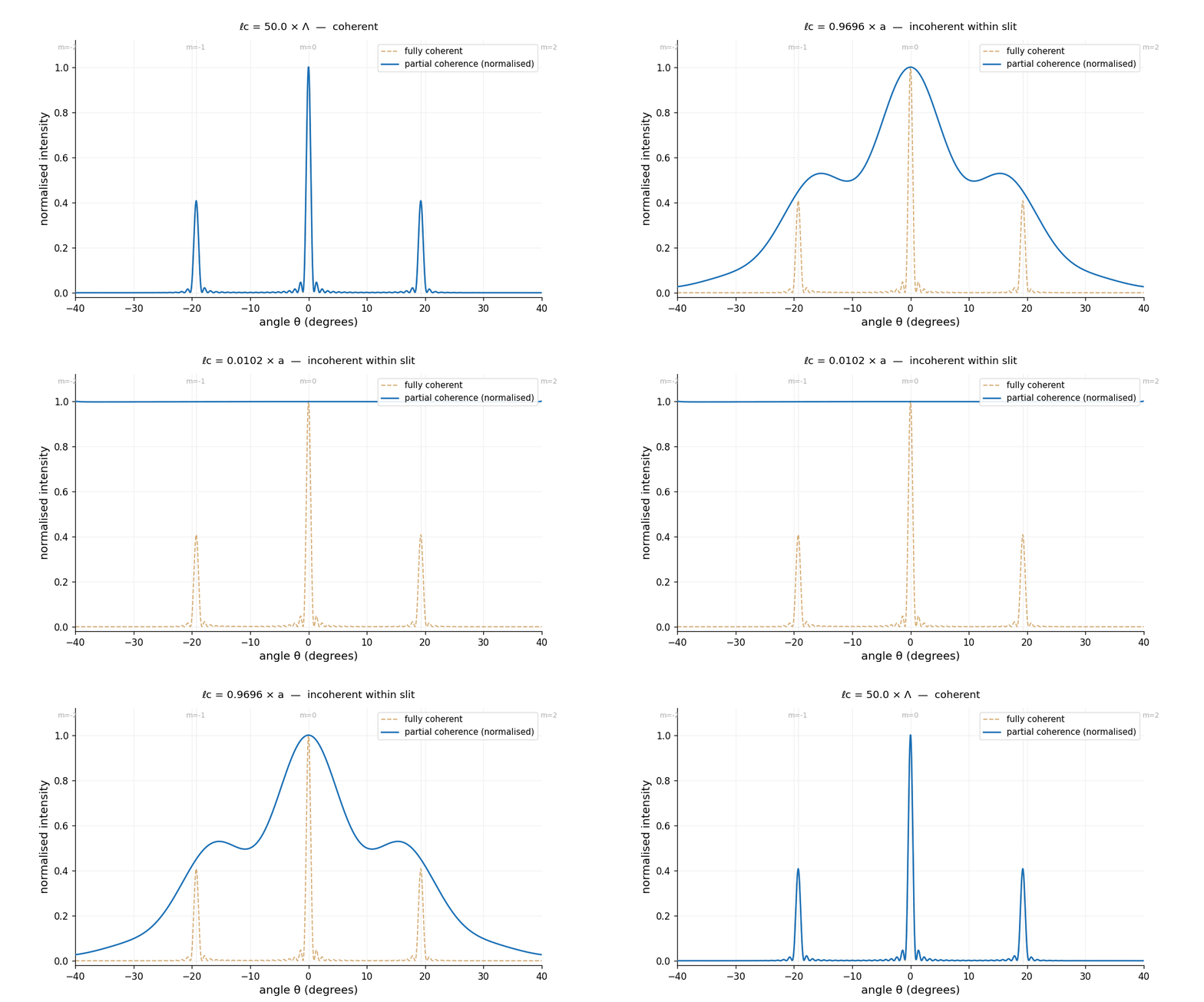
OK so here is the simulation.
The dashed orange line is what you would expect from the typical diffraction grating intensity profile which assumes perfectly spatially coherent light (ideal plane wave) incident on the grating.
As you can see when the coherence length is much larger than the slit, the resulting diffraction pattern approaches the perfect coherence limiting case.
One issue I had was the conservation of energy. Essentially when the coherence length was extremely short → 0, the total intensity would shrink. so obviously this is bad because thats a loss of conservation of energy.
Actually this is not an issue though! you see, what we computed was essentially the intensity contribution from interference effects. Even though the total intensity appears to go to zero, energy is conserved because this intensity is actually just showing up in the independent intensity sum part.
OK finally, lets go back to what we wanted to figure out initially.
Looking at the gif, we clearly see that as we increase our coherence length more and more, the "sharpness" of the peaks increases and approaches our ideal scenario.
The overall conclusion here is that we need to maximize our spatial coherence across the grating to give us the sharpest possible peaks.
- spatial coherence is roughly given by the van citerrt zernike theorem which tells us we need to make the angular width of our "source" (in this case our pinhole) as small as possible. This is done by either moving it further away or by shrinking the size or both.