...
A metal tube is attached to the valve and extends down to the lowest point of the bottle, and when the valve is opened, the high internal pressure (roughly 900) psi) forces the liquid nitrous up the tube and out of the valve, allowing the bottle to be used while standing upright. To work correctly, the siphon tube must be lined up with the outlet port so it points toward the bottom-rear of the bottle.
Note that some liquid may allow a successful fire at first even without a siphon tube. (deprecated)
If a non-siphon bottle is used, it typically dispenses gaseous nitrous because it draws from the top space. However, liquid can come out initially due to a few factors, and our current working theories are:
Linde may slightly overfill their bottlesThere may be a partial siphon tube or fitting that goes partway down the bottle;Cold/High Pressure: If the tank is full and very cold, the internal pressure can fluctuate.Sloshing or Inversion: If the bottle was tilted, moved, or partially inverted, the liquid inside can cover the outlet port, causing liquid to be pushed out instead of gas.Excessive Flow Rate: Opening the valve too quickly can cause a rush of liquid, especially if the tank is very full
Note that some gaseous nitrous may allow for successful ignition at first, but it cannot sustain ignition.
If the tank is accidentally filled with gaseous nitrous, there are a few easy ways to tell.
- Unexpectedly low pressure drop across fluid lines and valves
- Actually unclear about this one – theory would predict this but data shows on the order of ~30 psi of pressure drop across our system regardless of liquid or gaseous nitrous
- Unexpectedly high nitrous vapor pressure
- The system is designed so that some gaseous nitrous vents from the nitrous tank when filling. The boiloff of liquid nitrous that replaces the lost gas takes away heat, which cools the nitrous and lowers the vapor pressure. When filling with gaseous nitrous, this effect isn't as strong. We saw ~500 psi of nitrous tank pressure after filling with gaseous nitrous and ~400 psi of nitrous tank pressure after filling with liquid, under similar weather conditions. The exact final pressure after the fill is dependent on the fluids system, fill procedure, and ambient temperature, but it should be possible to tell the nitrous phase just from the vapor pressure after fill alone.
- No nitrous pressure recovery after vent/fire attempt
- After opening a vent valve or attempting to hotfire, if there is still liquid nitrous left in the tank, the tank pressure should be at least the nitrous vapor pressure. However, if the tank is accidentally filled with gaseous, the pressure will not recover.
Gerard Desjardins' Bottle Opening Technique
...
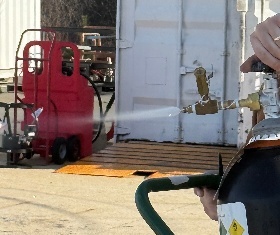
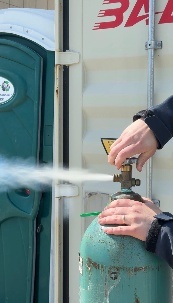
Gerard is the Lead Propulsion Test Engineer at bluShift, and he will crack the cap of the cylinder and (pointing it away from himself) open the valve to see a plume, at which point it is visually identifiable whether the plume is water liquid or gas. Note that is is NOT OBVIOUS if you have not seen it before.
GASEOUS LIQUID