...
OK I had claude solve this integral explictly so not only do we now know the limiting cases, we also analytically know the general solution.
I made a script that shows the resulting angular diffraction pattern for various incident transverse spatial coherence lengths and its shown below.
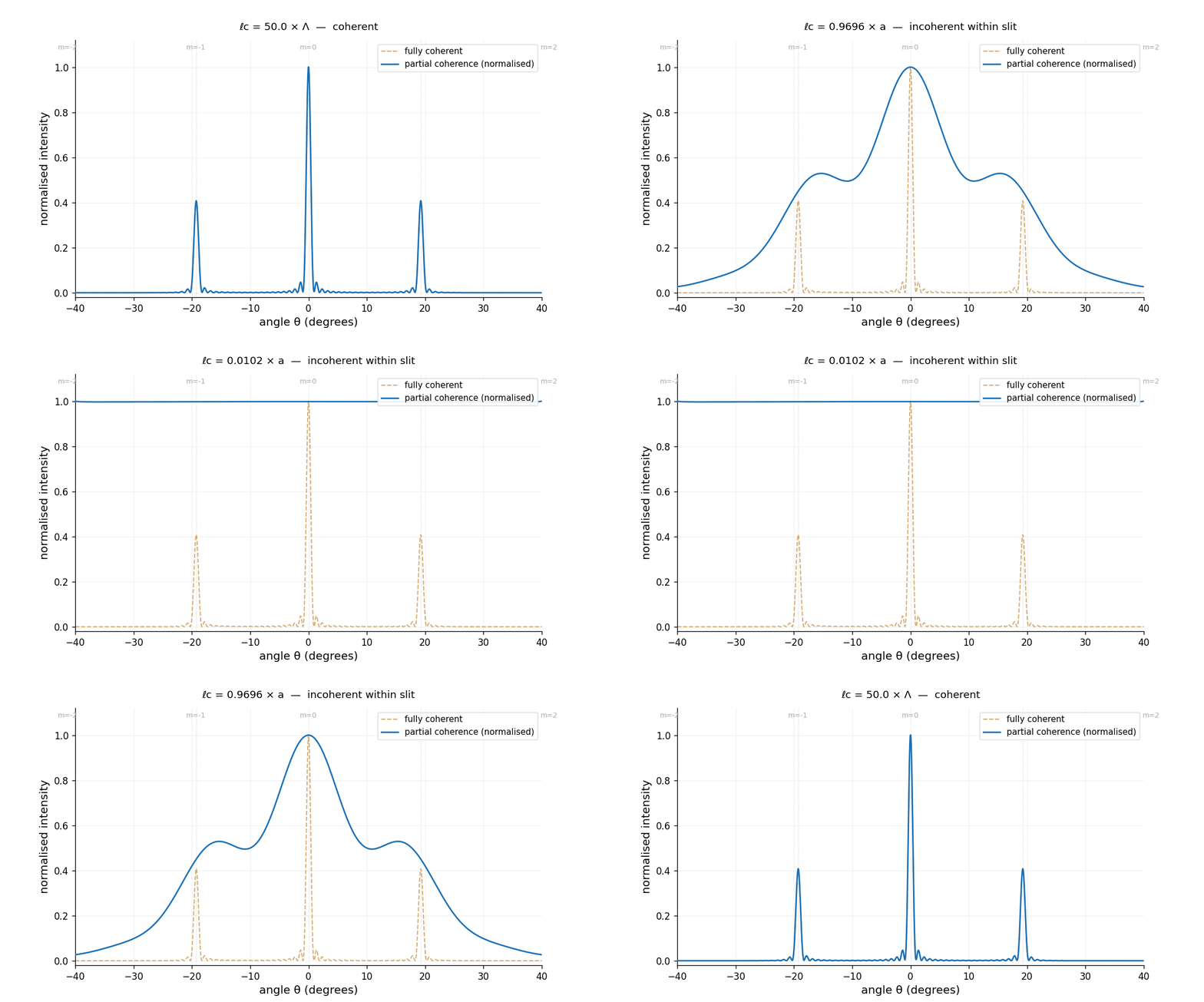
OK so here is the simulation.
The dashed orange line is what you would expect from the typical diffraction grating intensity profile which assumes perfectly spatially coherent light (ideal plane wave) incident on the grating.
As you can see when the coherence length is much larger than the slit, the resulting diffraction pattern approaches the perfect coherence limiting case.
One issue I had was the conservation of energy. Essentially when the coherence length was extremely short → 0, the total intensity would shrink. so obviously this is bad because thats a loss of conservation of energy.
Actually this is not an issue though! you see, what we computed was essentially the intensity contribution from interference effects. Even though the total intensity appears to go to zero, energy is conserved because this intensity is actually just showing up in the independent intensity sum part.
OK finally, lets go back to what we wanted to figure out initially.
Looking at the gif, we clearly see that as we increase our coherence length more and more, the "sharpness" of the peaks increases and approaches our ideal scenario.
The overall conclusion here is that we need to maximize our spatial coherence across the grating to give us the sharpest possible peaks.
- spatial coherence is roughly given by the van citerrt zernike theorem which tells us we need to make the angular width of our "source" (in this case our pinhole) as small as possible. This is done by either moving it further away or by shrinking the size or both.