Rocket Team Standard Atmosphere Model
Python module for computing atmospheric properties (T, P, ρ, speed of sound, from 0–110 km, anchored to actual launch-day ground
conditions instead of standard sea-level values as provided in US76
Reference information: 19770009539.pdf
**Repo:** https://github.com/shri-th/rocket-team-atmosphere-model.git
**Quick start:**
```bash
git clone https://github.com/shri-th/rocket-team-atmosphere-model.git
cd [repo-name]
pip install -r requirements.txt (check README and requirements.txt for full dependencies)
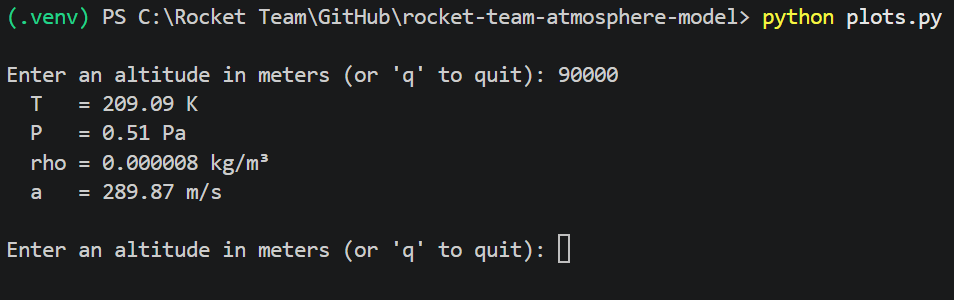
python plots.py
```
Edit `launch_site.py` (or the top of `plots.py`) with your measured pad
altitude, temperature, and pressure before running.
Want to contribute changes? Fork the repo and open a pull request, or ping for collaborator access.
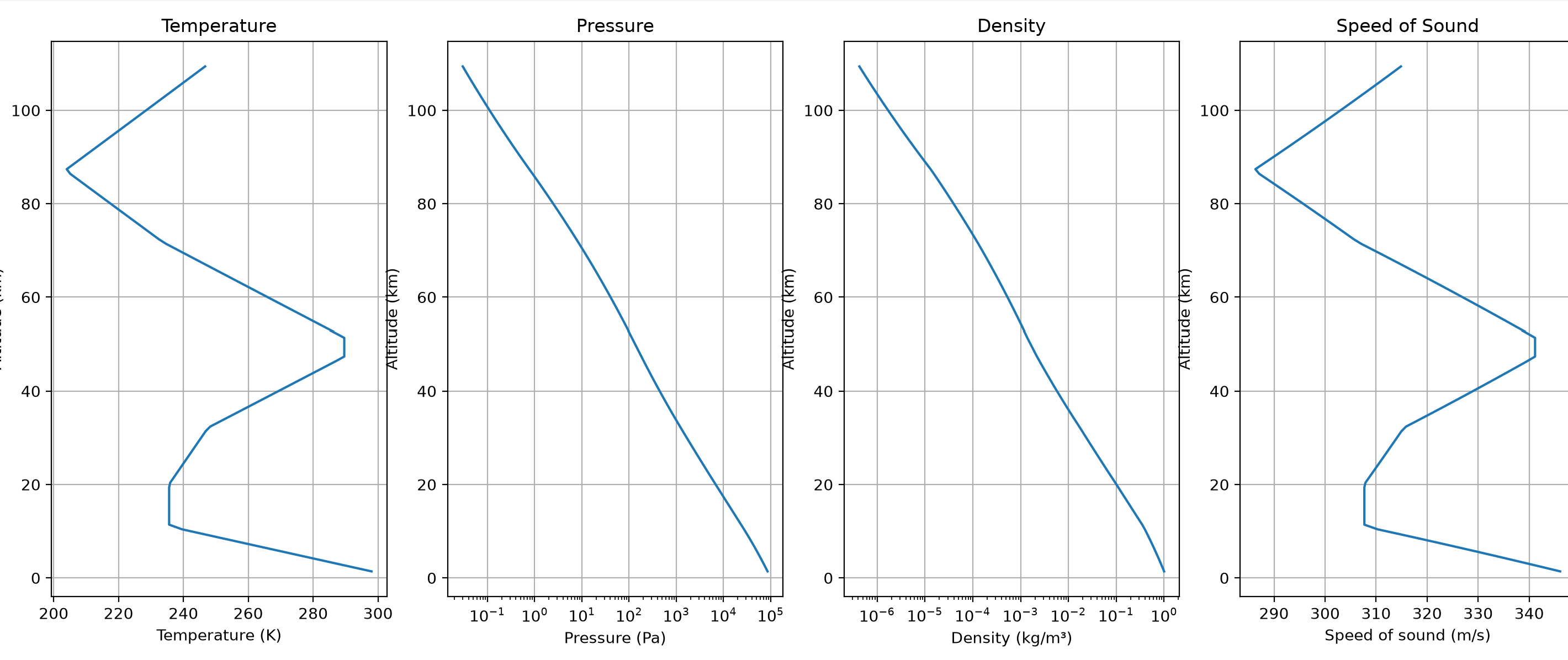
- Temperature: piecewise-linear function of altitude — the atmosphere is split into 8 layers (troposphere, stratosphere, mesosphere, etc.), each with its own fixed lapse rate (rate of temperature change with altitude). Model builds this layer table anchored to ground T instead of 288.15 K.
- Pressure: solved from the hydrostatic equation within each layer — either an exponential decay (in isothermal layers) or a power-law relation (in layers where temperature changes linearly), again anchored to ground P.
- Density: derived from the ideal gas law, ρ = P/(R·T), using the T and P already computed.
- Speed of sound: a = √(γRT) — depends only on temperature.
- Viscosity: Sutherland's Law, a semi-empirical formula for how air viscosity increases with temperature.
- Gravity: inverse-square falloff with altitude using Earth's radius, g = g₀(Rₑ/(Rₑ+h))².