Functional Requirements:
Parachutes
- Descent Velocities
- Drogue descent velocity: 65 - 165 ft/s
- Main descent velocity: <36 ft/s
- Redundancy in parachute deployment triggers
- Design:
- Required drag coefficient and high stability
- Easy to manufacture
Safety Factors
- Lines and attachments: 1.5 safety factor for shock force of parachute deployment calculated with rocket dry mass
- Parachute joints and seams: 3 safety factor
Recovery Trajectories:
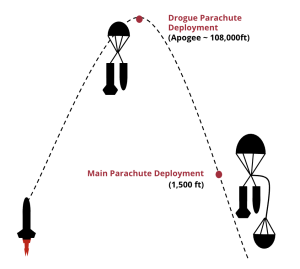
- Single Separation, Dual-Deployment (Tender Descender)
- First deployment (Drogue Parachute): Apogee (108,000 ft)
- Second deployment (Main Parachute): 1,500 ft
Parachute Sizing:
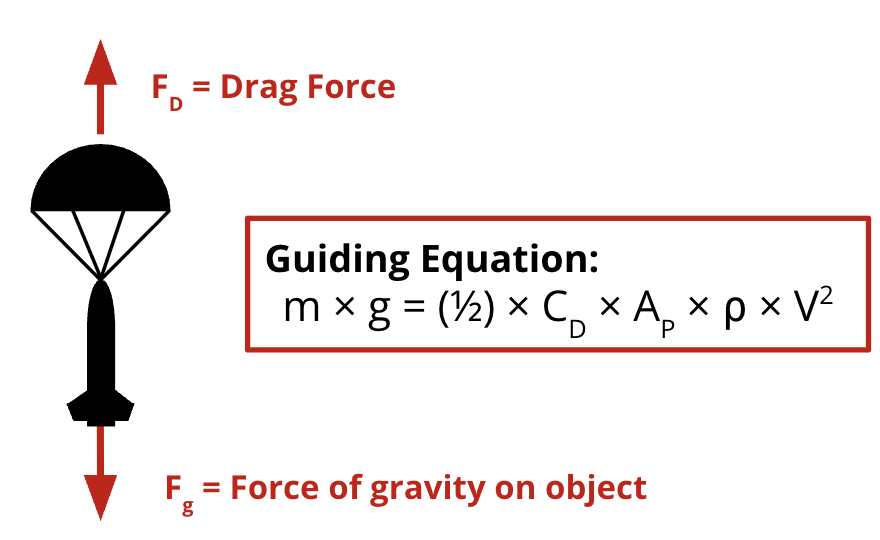
Design Constraints:
- Descent velocity (terminal velocity)
Want to Find:
- Diameter of parachute
Other Variables:
- Coefficient of Drag (CD):
- Estimation for Drogue: 0.55
- Estimation for Main: 1.6
- Will require testing to confirm
- Air density at deployment altitude
- Drogue: ~108,000 ft AGL
- Main: 1,500 ft AGL
- Launch: 2000 ft ASL
- Vehicle mass: 80.32lbs dry mass
Parachute Design Overview:
- Designing and sewing Zephyrus drogue and main parachutes in-house
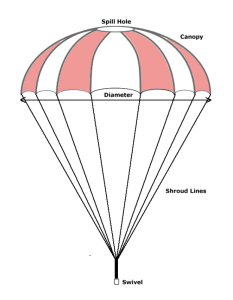
Parachute Components:
- Canopy
- Gores
- Vent/Spill Hole
- Shroud/Suspension Lines
- Shock Cord