...
The flame travels through the nozzle and goes through the main injector before coming out into the main chamber. The whole ASI assembly is at an angle so that it can shoot out the flame closer to where the nitrous exits the pintle orifices to maximize ignition probability. The nitrous itself should regen cool the pintle enough that it doesn't melt due to the ASI flame temp, but we do want to test whether or not the ASI plume would melt the pintle if the valves failed to open for whatever reason. This could be a major problem, as if we have a failed ignition during a hot fire attempt where the ASI fires but the throttle valves don't open, we may not know whether the pintle melted or not. We have an extra pintle tip that we'll try to test this on ASAP.
Flow Rate
Since this is an igniter, the flow rates of GOX and CH4 are very small, which presented some issues with sizing the annulus. To avoid tolerancing issues here, I opted to decouple flow rate from the ASI by having upstream orifice fittings with an area less than the annulus and GOX needle. McMaster orifices have flow data for water, which you can use to back out a discharge coefficient (Cd). Then, you can plug this Cd into the equation for choked flow through an orifice to obtain the mdot that this orifice sets.
In reality, you are uncertain about the pressure right before the orifice fitting, so if you actually want to characterize your pressures well, you should have PTs reading the upstream orifice fitting pressures and the chamber pressure, and then use the pressures that you see in the data to iterate towards your desired mdot.
P&ID
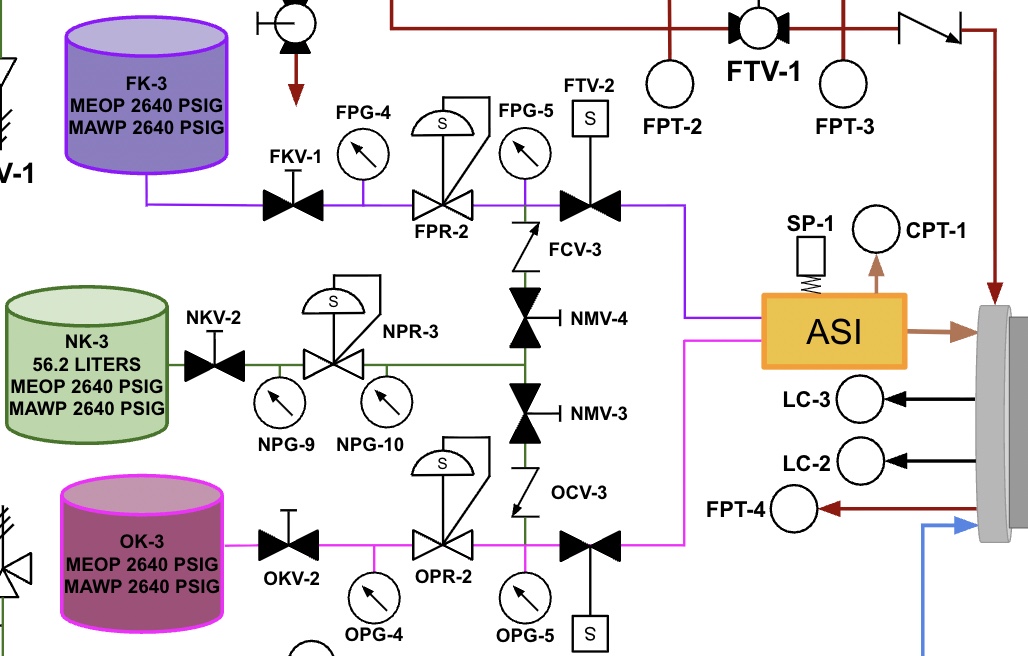
This image shows the P&ID for the ASI, which is pretty standard. Each propellant line has a regulator and a solenoid valve to precisely time propellant delivery to the ASI. At the test site, FK-3 and OK-3 are ~10 ft away from the test article and are behind separate concrete walls to isolate the system sufficiently. However, NK-3 is next to the test stand.
For a more in-depth ASI testing campaign, there would also be PT's before the orifice fittings on the propellant lines.
RF
During our testing campaign, we encountered significant RF issues. Initially, we observed that whenever we turned on the spark plug, it reset Papyrus (our avionics system). Sometimes, it would even cause the huge speakers above the hangar to static. It was really spooky. To mitigate this, we bought a bigger spark plug that had a resistor inside of it, which seems to have solved the issue. Additionally, we insulated all wiring to the spark plug heavily. We initially chose a non resistor spark plug because it was very small and thus easier to fit in the assembly, but I think that getting the bigger one and fitting it in will save a lot of headache.
Purging
The ASI initially did not have purging capability, but we realized that in the event of a failed ignition, there would be some residual methagox mixture left in the chamber, which is a hazard if approached. To make the system safer, we added purging capability to the ASI by having some tee fittings that inletted nitrogen from a separate nitrogen cylinder (not the same cylinder that feeds nitrogen to the rest of the engine). There are manual valves and check valves to prevent backflow into the lines during ASI operation; additionally, we set the nitrogen reg to be at a higher pressure than the ASI operating pressures so that it is physically impossible for the gas to backflow into the nitrogen lines unless there was some significant over pressurization event in the chamber.
Fire Videos