...
Maybe if you're at FAR and your nitrous is at like 90 degrees it will, but for us in the East Coast we've found that using a solid motor to light the main engine is a lot less reliable. This led us to design an Augmented Spark Igniter (ASI), which uses two gaseous props and a spark plug to generate a very hot flame that reliably ignites the main mixture. Although our lander is Nitrous/IPA, we chose gaseous methane and oxygen for our ASI propellants to maximize ignition reliability for our ground testing campaign.
Specifications
Thrust: 10N
Chamber Pressure: 100 psi
Mixture Ratio: 3.0
Flame Temp: 3300K (damn)
Injector
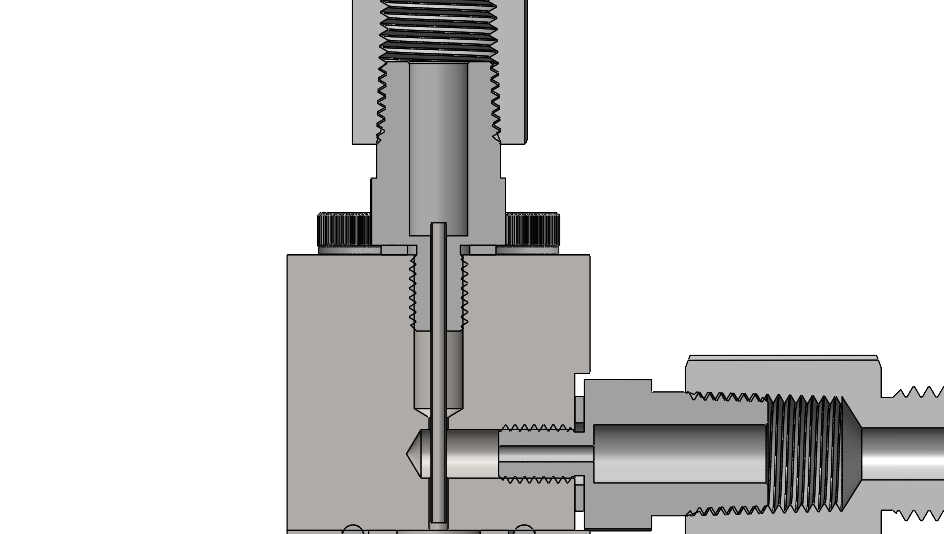
(NOTE): The fittings that interface with the injector are NOT the fittings we used. These fittings were COTS fittings from McMaster that were initially had YorLok nuts on them, but were unscrewed. THESE FITTINGS WILL SHEAR. They were 10-32 threads, we scaled up to a custom fitting with a 1/4-32 male thread and we haven't experienced shearing when compressing the copper crush.
...
Since this is an igniter, the flow rates of GOX and CH4 are very small, which presented some issues with sizing the annulus. To avoid tolerancing issues here, I opted to decouple flow rate from the ASI by having upstream orifice fittings with an area less than the annulus and GOX needle. McMaster orifices have flow data for water, which you can use to back out a discharge coefficient (Cd). Then, you can plug this Cd into the equation for choked flow through an orifice to obtain the mdot that this orifice sets. . Pointer: the Cd for a straight-edged orifice is usually around 0.7.
In reality, you are uncertain about the pressure right before the orifice fitting, so if you actually want to characterize your pressures well, you should have PTs reading the upstream orifice fitting pressures and the chamber pressure, and then use the pressures that you see in the data to iterate towards your desired mdot.
...