...
Maybe if you're at FAR and your nitrous is at like 90 degrees it will, but for us in the East Coast we've found that using a solid motor to light the main engine is a lot less reliable. This led us to design an Augmented Spark Igniter (ASI), which uses two gaseous props and a spark plug to generate a very hot flame that reliably ignites the main mixture. Although our lander is Nitrous/IPA, we chose gaseous methane and oxygen for our ASI propellants to maximize ignition reliability for our ground testing campaign.
Specifications
Thrust: 10N
Chamber Pressure: 100 psi
Mixture Ratio: 3.0
Flame Temp: 3300K (damn)
Injector
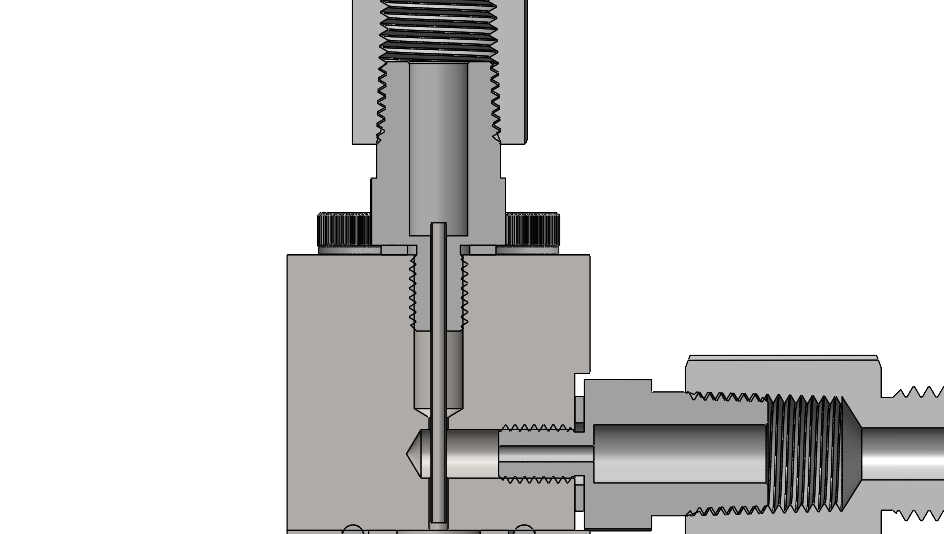
(NOTE): The fittings that interface with the injector are NOT the fittings we used. These fittings were COTS fittings from McMaster that were initially had YorLok nuts on them (link), but were unscrewed. THESE FITTINGS WILL SHEAR. They were 10-32 threads, we scaled up to a custom fitting with a 1/4-32 male thread and we haven't experienced shearing when compressing the copper crush.
...
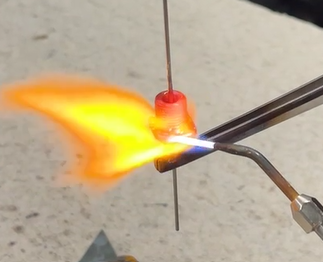
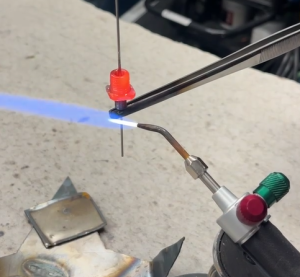
The tube is a micro piece of SS hard line (0.05" OD) that you can get from McMaster, and is brazed to the inside of the custom fitting. This joint actually wasn't that hard to braze – you can put flux and filler metal into the larger hole on the inside of the died 1/8 NPT side. Then, you can slide the tube inside and heat up the fitting from the outside with a propane torch. IMPORTANT: In the CAD photo, the needle tube is only barely sticking out above the surface of the fitting on the inside; this is supposed to be mOsT oPtiMaL but in reality it needs to stick way above that to allow the flux to sit below and not clog the inside of the needle. Once the stainless steel fitting gets to a rose red (basically eyeballing that the temperature is ~650-870 C or 1200-1600 F, as this is the necessary heat range to apply the silver-based brazing flux (should turn clear at this temperature) and add in the filler metal)), the joint has probably heated up enough on the inside to melt the flux and seal it. Example below!
| View file | ||||
|---|---|---|---|---|
|
Another note: after brazing, you'll need to cut the needle to size, which is hard to do without bending it slightly. It doesn't matter if the inlet side of the needle is slightly bent, but if the needle is bent on the outlet side, it will lose concentricity with the annulus and produce uneven combustion. The uneven combustion may not be a problem, but I'd be very careful when cutting the needle down to size!
Please make sure to leak test the brazed joint if you don't want to blow up; it's an interpropellant seal!
Chamber
add cross sections
...
The PT is also separated a good amount from the chamber by around 6 inches of hard line; there are some graphs online that have correlations between flame temp and how far away your sensors should be. The air inside of the PT hard line will act as an insulator that will protect the PT from the hot flame in the chamber. A lot of designs Designs on the solid rocket side don't recess flame-probing sensors like this and are fine, but since our reliability and test count requirements are much more stringent demanding we think this is necessary.
Every fitting connecting to the ASI is a copper crush except the fitting that connects it to the main injector, which is an ORB fitting. We chose an ORB fitting here mostly due to the fact that it'd make installation and clocking way easier, and also because we already had an ORB porting tool of the right size lol. However, we recently de-integrated the ASI and observed some O-ring melting. Currently our potential solutions are are buying FFKM O-rings which are rated to 600 F (previous high temp silicone O-rings are rated to 450 F) or just burning for less time. However, we are concerned that the FFKM can decompose into toxic chemicals (HF) if it still melts. I'm honestly kind of surprised this is an issue; one of the reasons why I chose steel as the material is because I reasoned that it would not conduct heat as quickly to the O-ring on the outside compared to a highly thermally conductive material like copper. But I guess that's not good enough.
Nozzle
add cross sections
The "nozzle" is not really a traditional rocket nozzle, as it does not have a diverging section. Its converging angle is also not optimized because we wanted it to be easy to manufacture (just drill with two different sizes to get a converging geometry). There isn't really a reason why the igniter flame needs to be supersonic – if they come it comes in sonic that's fine. So, we didn't see a need to drill on the other side for a diverging section.
The flame travels through the nozzle and goes through the main injector before coming out into the main chamber. The whole ASI assembly is at an angle so that it can shoot out the flame closer to where the nitrous exits the pintle orifices to maximize ignition probability. The nitrous itself should regen cool the pintle enough that it doesn't melt due to the ASI flame temp, but we do want to test whether or not the ASI plume would melt the pintle if the valves failed to open for whatever reason. This could be a major problem, as if we have a failed ignition during a hot fire attempt where the ASI fires but the throttle valves don't open, we may not know whether the pintle melted or not. We have an extra pintle tip that we'll try to test this on ASAP.
Flow Rate
Since this is an igniter, the flow rates of GOX and CH4 are very small, which presented some issues with sizing the annulus. To avoid tolerancing issues here, I opted to decouple flow rate from the injector by having upstream orifice fittings with an area less than the annulus and GOX needle. McMaster orifices have flow data for water, which you can use to back out a discharge coefficient (Cd). Then, you can plug this Cd into the equation for choked flow through an orifice to obtain the mdot that this orifice sets. Pointer: the Cd for a straight-edged orifice is usually around 0.7.
In reality, you are uncertain about the pressure right before the orifice fitting, so if you actually want to characterize your flow rates well, you should have PTs reading the upstream orifice fitting pressures and the chamber pressure, and then use the pressures that you see in the data to iterate towards your desired mdot.
P&ID
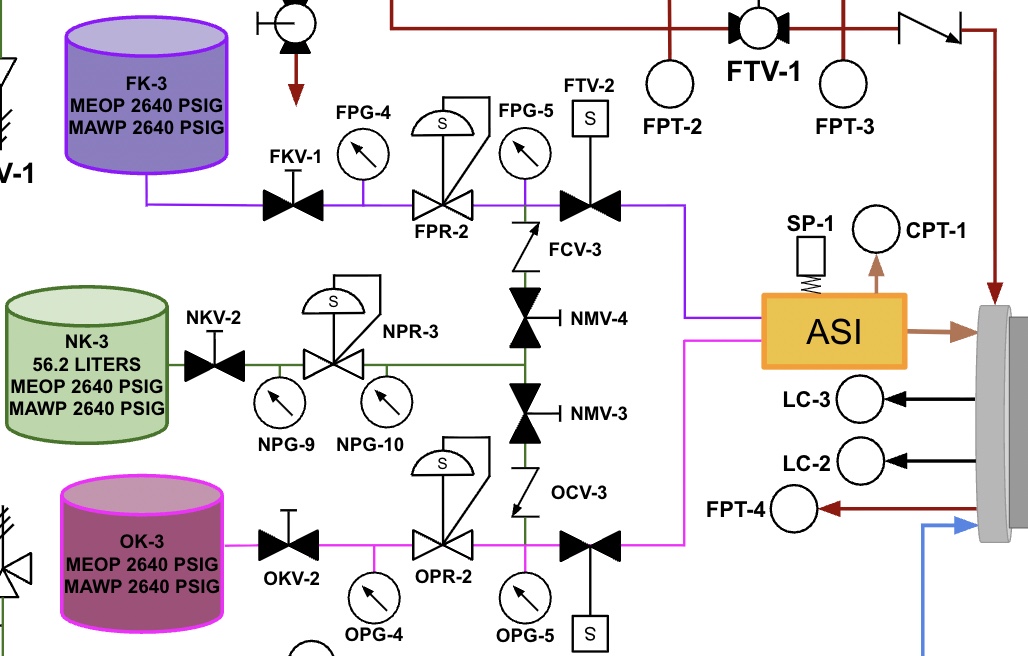
This image shows the P&ID for the ASI, which is pretty standard. Each propellant line has a regulator and a solenoid valve to precisely time propellant delivery to the ASI. At the test site, FK-3 and OK-3 are ~10 ft away from the test article and are behind separate concrete walls to isolate the system sufficiently. However, NK-3 is next to the test stand.
For a more in-depth ASI testing campaign, there would also be PT's before the orifice fittings on the propellant lines.
RF
During our testing campaign, we encountered significant RF issues. Initially, we observed that whenever we turned on the spark plug, it reset Papyrus (our avionics system). Sometimes, it would even cause the huge speakers above the hangar to static. It was really spooky. To mitigate this, we bought a bigger spark plug that had a resistor inside of it, which seems to have solved the issue. Additionally, we insulated all wiring to the spark plug heavily. We initially chose a non resistor spark plug because it was very small and thus easier to fit in the assembly, but I think that getting the bigger one and fitting it in will save a lot of mystical headaches.
Purging
The ASI initially did not have purging capability, but we realized that in the event of a failed ignition, there would be some residual methagox mixture left in the chamber, which is a hazard if approached. To make the system safer, we added purging capability to the ASI by having some tee fittings that inletted nitrogen from a separate nitrogen cylinder (not the same cylinder that feeds nitrogen to the rest of the engine). There are manual valves and check valves to prevent backflow into the lines during ASI operation; additionally, right before firing the ASI, we set the nitrogen reg to be at a higher pressure than the ASI operating pressures so that it is physically impossible for the gas to backflow into the nitrogen lines unless there was some significant over pressurization event in the chamber. We then unscrew the regulator to set the pressure back to a reasonable purging pressure (100-200 psi). I love self venting regulators.
Feed System Pressures
The feed system pressures in the ASI were chosen to be a "good bit" higher than the chamber pressure to mitigate backflow of gas in the main combustion chamber into the ASI lines. This is almost a non issue because the solenoids are almost guaranteed to close after the ASI burn time, but it's a good practice to have. Our oxidizer reg pressure is currently at 400 psi, and our fuel reg pressure is currently at 550 psi. Our main chamber pressure is 350 psi.
Once the igniter solenoids close, there will be a trapped volume of ASI gas between the ASI chamber and the main chamber, which should "insulate" the ASI well enough. The main chamber pressure will push on this insulated pocket, which will push on the PT in the ASI and give a pressure reading.
Fire Videos
| View file | ||||
|---|---|---|---|---|
|