Overview
This fin can is the second flight candidate for Hermes III. The changes from the first flight candidate include larger leading edges, a different laminate stack up, the introduction of foam in the vacuum bagging process, larger fillets, fillets that partially cover the leading edges, and less bubbly fillets.
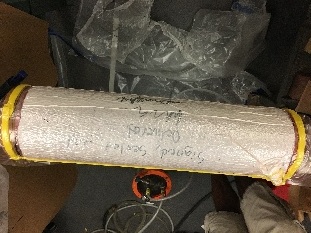
This fin can is referred to as Dusty or Fly Trap. It is the third fin can made for Hermes III, after Rusty and Crusty.
Tube Preparation
- Kit the necessary materials for the overwrap layup. The sizes listed in the table below are given such that there are 3 layers of carbon fiber that run 22" long on a ~19" circumference tube. 22" is chosen so that there is one inch of exposed left on both sides of the 24" phenolic tube, which will be used for the vacuum tape. The breather, peel ply, and release film are sized to wrap around the tube with several inches spare for vacuum tape.
Kitting set up:
Overwrap Kit MaterialSizesHigh temp vacuum bag (pink, no holes)** 30" x 24" Breather cloth (white, fuzzy) 22" x 24" High temp peel ply (blue nylon or white polyester) 22" x 24"
High temp release film (red with holes) 22" x 24"
Carbon fiber (3 layers, (0/90))
22" x 60" Wax paper 24" x 60" Two tables in Gelb lab, with fresh paper laid on top.
Make sure to wear gloves when cutting everything.
Be wary of stray pieces of painters tape from the wax paper touching the carbon fiber because this could cause fraying.
- Use the sharp shears for the breather cloth. Everything else can be cut using the pizza cutter.
- For the carbon fiber and wax paper: Kit the wax paper first by laying two 12"x60" sheets next to each other. Tape the two together either directly side by side with no overlap or with two inches of overlap. Use scotch 77 to spray a light layer of spray glue on the wax paper. Make sure to rub out any bubbles of spray glue material that globbed up on the wax paper (any glue globs on the wax paper is an area where there won't be epoxy). Roll out the carbon fiber on a freshly cleaned table such that there's at least 60" of length. Place the wax paper on the carbon fiber, glue side down. Gently flatten the wax paper over the carbon fiber with your gloved hands. Use the pizza cutter to trim the carbon fiber to size. Weigh the carbon fiber and wax paper combination.


Sand the tube with low grit sandpaper to roughen it up.
- Do the layup.
- Grab a pole and wrap it with wax paper. This pole will slide through the tube and hold it up during layup.
- Secure the pole ends and the tube with two tables, and add weights or something to make sure someone can't accidentally knock the pole off.
- Cover the area beneath the tube with lots of paper/cardboard/etc. Just make sure that any epoxy drips are caught so that the floor isn't covered in epoxy.
- Mix Systems 3000 epoxy. Make sure to record the amount used.
- While holding the tube in place, gradually unroll the carbon fiber onto the tube, while pouring epoxy over it. Use squeegees to spread the epoxy. Be careful not to use too much epoxy because this will reduce the overall strength of the part.
- Continue unrolling the carbon fiber from the wax paper until finished. Be careful to keep the same amount of tension on the carbon fiber throughout its length to prevent warping.
- If you notice warps or areas where it doesn't look like the fiber is going in the 0/90 degree direction, pause for a moment and try to massage the fibers back into place.
- The epoxy has a two hour pot life, so hopefully you've finished the layup in 90 minutes and now have time to bag.
- Vacuum bag
- Wrap the part in peel ply
- Wrap the part in release film
- Wrap the part in breather. Consider using two layers of breather because our layups are pretty wet.
- Wrap the part in the vacuum bag. Be sure to add vacuum tape to the ends of the tube.
- Slide the vacuum connector into the part.
- Pull vacuum and listen for leaks. You're aiming for -26 mm Hg.
- Let it cure at room temperature for 24-36 hours.
- Bring into the oven to cure for an additional 12 hours.
Root Bond and Root Fillet
The root bond refers to the bond between the bare fiberglass fins and the overwrapped phenolic tube. The purpose of this bond is to ensure that the fins are attached perpendicular to the tube. This attachment is very weak and will break if you knock it, so be very careful handling the fin can after the root bond. We use systems 3000 for it (probably overkill because it's a dumb weak bond) and a root bond jig made from acrylic. Schedule 36 hours for the root bond.
The root fillet refers to the fillet of epoxy between the fiberglass fin and the CF tube. The fillets are important because they're the real structural attachment between the fin and the tube. Once you have the fins bonded in the right position, you beef them up with a fillet. Using Systems 3000 for the fillet means you have to add Cabosil or Colloidal Silica to thicken up the epoxy because it's a laminating epoxy. Make sure you're consistent with the amount of thickening agent you use. Also really important to note that each fillet takes 24 hours to cure, and you can really only do 2 fillets at a time. At the proper rate, this process should take 7 days.
Required Materials:
- CF overwrapped tube
- Systems 3000 epoxy (resin and hardener)
- Acrylic fillet radius tool
- Gloves
- Respirator
- Cabosil
- Popsicle sticks
- Epoxy boats or paper cup (for mixing epoxy)
- Painters tape
- Ruler
- Acetone and shop towels (to clean up epoxy on acrylic tools)
- Vacuum
- Root bond jig
- Sandpaper (220 grit)
Root Bond Procedure
Tip to Tip Ply Number | Orientation | Size | WP Kitted/Total | CF Kitted/Total |
|---|---|---|---|---|
| 1 (smallest) | +-45 | 20x22 | 4/4 | 0/4 |
| 2 | 0/90 | 20x22 | 4/4 | DONE |
| 3 | +-45 | 20x22 | 4/4 | 0/4 |
| 4 | 0/90 | 20x22 | 4/4 | DONE |
| 5 | +-45 | 20x22 | 4/4 | 0/4 |
| 6 | 0/90 | 20x22 | 4/4 | DONE |
| 7 | 0/90 | 20x26 | 4/4 | DONE |
| 8 (largest) | 0/90 | 22x26 | 4/4 | DONE |
extra: 4 of (0/90) 20x22
**Originally, Dusty was supposed to be the 2nd completed fin can, but a series of unfortunate root bonding accidents resulted in Crusty being completed before Dusty. Therefore, despite the fact that the overwrap for Dusty was done a week before the overwrap for Crusty, Crusty is now referred to as the 2nd fin can.