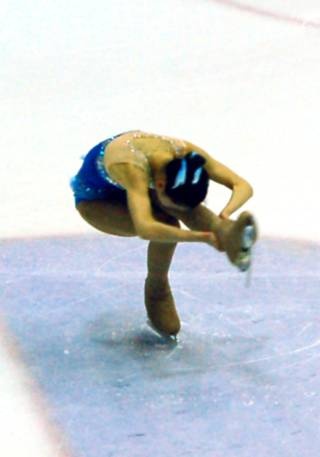
Consider an ice skater performing a spin. The ice is very nearly a frictionless surface
A skater spinning around has constant angular momentum, but can change his or her Moment of Interia by changing body position. What happens to their rate of rotation when they do so?
Part A
Assume that the skater originally is standing straight up while spinning, with arms extended. He or she then draws his or her arms inwards tightly to the sides. How does the angular velocity change?
Solution
System: The skater is treated as a rigid body in two configurations – one with the arms extended, the other with arms held close.
Interactions: External influences – none. The skater is moving on a frictionless surface.
Model: Single-Axis Rotation of a Rigid Body
Approach:
Diagrammatic Representation
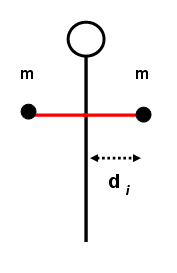
Consider the skater intially as a massless vertical pole with the arms modeled as massless rods of length Li with a point mass m at each end.
After contracting the skater's arms, the two masses are each a distance Lf from the body
Mathematical Representation
The definition of the Moment of Inertia is:
Unknown macro: {latex}
\begin
Unknown macro: {large} [ I = \sum {m r^{2}} ] \end
So that if we calculate the initial Moment of Inertia about the vertical pole that is the skater's torso, we get:
Unknown macro: {latex}
\begin
Unknown macro: {large}
[ I_
Unknown macro: {rm i} = 2 m d_
] \end
For the "final" configuration the Moment of Inertia becomes:
Unknown macro: {latex}
\begin
Unknown macro: {large}
[ I_
Unknown macro: {rm f} = 2 m d_
] \end
The Angular Momentum L has a magnitude given by
Unknown macro: {latex}
\begin
Unknown macro: {large} [ L = I \omega ] \end
so the initial angular momentum is
Unknown macro: {latex}
\begin
Unknown macro: {large}
[ L_
Unknown macro: {rm i} = I_
\omega_
Unknown macro: {rm i} = 2 m d_
\omega_
Unknown macro: {rm i}
] \end
and the final angular momentum is
Unknown macro: {latex}
\begin
Unknown macro: {large}
[ L_
Unknown macro: {rm f} = I_
\omega_
Unknown macro: {rm f} = 2 m d_
\omega_
Unknown macro: {rm f}
] \end
Since the Angular Momentum is unchanged, the initial and final expressions should be equal. This means that
Unknown macro: {latex}
\begin
Unknown macro: {large}
[ d_
Unknown macro: {rm i} \omega_
= d_
Unknown macro: {rm f} \omega_
] \end
or
Unknown macro: {latex}
\begin
Unknown macro: {large}
[\omega_
Unknown macro: {rm f}
= \omega_
Unknown macro: {rm i}
\frac{d_{\rm i}}{d_{\rm f}} ] \end
After drawing in his or her arms, the skater is spinning much more rapidly, without the application of any external forces or torques.
Part B
Consider the same basic situation as in Part A, but now suppose that the wall has friction. If the coefficient of static friction between the floor and the ladder is only 0.15, what is the minimum coefficient of static friction needed between the wall and the ladder to prevent the ladder from slipping?
Solution
System: The ladder as a rigid body.
Interactions: External influences from the earth (gravity) the wall (normal force and friction) and the floor (normal force and frictional force).
Model: Single-Axis Rotation of a Rigid Body and Point Particle Dynamics.
Approach:
An Important Assumption
The minimum coefficient of friction will occur when both friction forces are maxima. Thus, we have the important relationships:
Unknown macro: {latex}
\begin
Unknown macro: {large}
[ |F_
Unknown macro: {f,x}
| = \mu_
Unknown macro: {s,f}
|F_
Unknown macro: {f,y}
| ]
[ |F_
Unknown macro: {w,y}
| = \mu_
Unknown macro: {s,w}
|F_
Unknown macro: {w,x}
| ]\end
Diagrammatic Representation
Because we know the floor's static friction coefficient, we can streamline the solution by switching our choice of axis.
Unable to render embedded object: File (ladder2.jpg) not found.
Mathematical Representation
The resulting equations are:
Unknown macro: {latex}
\begin
Unknown macro: {large}
[ \sum F_
Unknown macro: {x}
= F_
Unknown macro: {w,x}
- \mu_
Unknown macro: {s,f}
F_
Unknown macro: {f,y}
= 0 ]
[ \sum F_
Unknown macro: {y}
= - mg + F_
+ \mu_
Unknown macro: {s,w}
F_
= 0 ]
[ \sum \tau = - mg (L/2) \cos\theta + F_
Unknown macro: {f,y}
L\cos\theta - \mu_
Unknown macro: {s,f}
F_
L \sin\theta ]\end
The only equation that can be solved immediately is torque balance, which gives:
Unknown macro: {latex}
\begin
Unknown macro: {large}
[ F_
Unknown macro: {f,y}
= \frac
Unknown macro: {mg}
{2\left(1-\mu_
Unknown macro: {s,f}
\tan\theta\right)} = \mbox
Unknown macro: {125 N}
]\end
We can then substitute this result into the equation of x-force balance to find:
Unknown macro: {latex}
\begin
Unknown macro: {large}
[ F_
Unknown macro: {w,x}
= \mu_
Unknown macro: {s,f}
F_
Unknown macro: {f,y}
= \mbox
Unknown macro: {18.8 N}
]\end
Finally, we can find the required coefficient of static friction to be:
Unknown macro: {latex}
\begin
Unknown macro: {large}
[ \mu_
Unknown macro: {s,w}
= \frac{mg-F_{f,y}}{F_{w,x}} = 1.19 ] \end