Teamlead: Ezra Eyre
The Zephyrus P-Class Motor (Persephone) changed a lot after CDR (December 2025) over the course of Spring 2026. This page will document the final (successful) version of this motor. But how did we get there?
- CDR Slides (Dec. 7th 2025): Project Zephyrus Solid Propulsion CDR.pdf
- Play-by-play of Spring 2026 (testing & manufacturing of Persephone: Design Changes Play by Play
Design Changes Post CDR
- Design Changes Post CDR
- CDR Desgin:
- gap between grain faces (grain faces are burning)
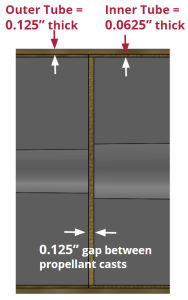
- bonding grain faces (epoxy) → new open motor design
- Test launch:
- planning to use the same case
- have long empty phenolic → changed to have normal phenolic length and push the forward closure down (spacer between the forward closure and FRR)
- CDR Desgin:
- Mix 1 (feb 7): (P motor and test launch)
- mid concial came back soft (forgot to put in plasticizer)
- why? chaotic mixing, added initial column to the table
- idea: more scales (one for each bowl)
- action: make lids for the vacuums, bring mixer up to larry's
- time line changes:
- previous timeline:
- only statiuc fiure p motor grain (same hardware)
- new timeline:
- static fire test launch grain (so we can be a go for test launch) → at mix 2 gonna mix mid conical AND new test launch grain (for launch)
- previous timeline:
- mid concial came back soft (forgot to put in plasticizer)
- Design Change: separate cases for test launch and P motor
- last year:
- hydrostatic tested without bolts torqued → leaked
- hydrostatic tested WITH bolts torqued → did not leaked
- So! thought would leak if the forward closure was super far from FRR (no clamping on orings from the bolts)
- last year:
- Hydrostatic 1 (test launch case, failure):
- observations:
- gapping between the lip of FRR and case, and lip of nozzle and case
- plastic deformation of holes in FRR and nozzle carrier
- friction!!! to stop the frr and the nozzle from moving! → thats where we get our torque requirement now. new complicated spreadsheet!
- observations:
- Mix 2 (feb 28th): (2nd test launch motor and mid conical)
- test launch grain different than static fire test launch grain
- redesigned to get more thrust of the rail
- inner phenolic tube for test launch grain was cracked → okay bc outer was not cracked and burnthru in 2-3 seconds would not happen
- test launch grain different than static fire test launch grain
- Static fire (test Launch) (3/14):
- yay!!! it worked!! but omg the pressure was 400psi higher than expected WATTTTTT (and shorter burn)
- mayyybeeeee hdyrostatic should go to 1.75 safety factor teehee (isntead of 1.5)
- we saw consistently that motors burn at higher pressures than simmed → widened nozzle throat diamter to lower pressure
- Static Fire (P motor) (3/21):

- it blew up
- had widened nozzle
- epoxied grain faces could have burned? but if they did would only have increased pressure by 100psi
- maybe propellant cracked from demandreling???
- case failure → net section failure on bolts, maybe some bearing failure first?
- countersinking too far?
- oring failure? → weakened aluminum
- rushed integration → probably saw an oring slice but didn't deintegrate
- path forward:
- make demandreling easier
- cast motor in one section
- reducing risk of over pressuriziation
- change bolt calcs to increase safety factors to normal levels
- always fucking retingrate if u see any specks whatsoever (uinless those specs or those in thr oring grease which are transulecent oh god)
- DONT rush integration
- clean area for bolts/generally icnreasig cleanliness → changed integration procedure
- Hydrostatic (test launch hardware):
- a couple bolt holes on the FRR plastical deformed like hdyrostatic 1, decided it was okay to move forward cus it was only a couple bolts and tilt was less severe than hyudrostatic 1
- Recharacterization → to be talked about later
- Test Launch yay!!!!
- no pressure data
- hey avionics can we please have a pressure transicer spot on avionics boards
- also not space with airbrakes? space on avionics?????
- no pressure data
- Mix 3: P motor
- mandrel improvements
- bit fillets (.15 radius)
- finocyl sectionw as slightly conical
- how conical?
- test in open motor → take average of fin width and core size for each ifnocyl section and plug those in to open motor, maybe instead trying to make Surface area match between open motor and reality isntead
- minimze gaps between sections (epoxy and sand smooth)
- sanded the whole mandrel to 400 grit sandpaper
- 10 layers of mold release (maybe 2 bottles total)
- mandrel improvements
List of things to document:
- Carbon Winder + mandrel prep for carbon winder
- Rachel - movy windy motors + things to change
- explore options that are not tape for keeping film in in place
- document last hydrostatic - tiki
- Rachel - fix cad
- Rachel - movy windy motors + things to change
- Hydrostatic 1 failure
- angelina document
- all bolt design changes throughout the spring semester
- increased length of engagement
- 14 to 24 bolts
- 2 rows of 14 vs 2 rows of 12
- follow integhration procedure (have prinbted procedure)
- Static Fire P motor 1
- anglina and ezra
- Static Fire P Motor 2 - siyona, divya
- While mounting the motor upright we noticed that the order of placing the stakes and rope contributed to the motor to slant. So we had two people hammer the stakes and tie the rope on opposite ends.
- At the time of ignition the motor slightly stalled and then "coughed" a flame (small flame, stall, then full flame). As time continued the flame quickly lost intensity and stopped earlier than expected.
- There was a hole created on the rear end of the case that we attributed to a thinning in the liner due to inconsistent sanding. This caused the flame to fire from both the top and bottom of the case. This was a new failure mode we had not considered, reflecting a need to standardize the sanding process.
- ezra
- drilling case holes + countersinking
- best practices, what the jigs looked like, with sldprts
- integration lessons learned - tiki, ezra
- The integration process may take up to an entire day depending on various factors. Preparation and manpower are critical for making integration proceed smoothly. Below are helpful lessons beyond what is included in the SOP.
- Include the case holes deburring process as a part of manufacturing, not integration. Careful and precise deburring minimizes the risk of o-ring slicing during integration, which may lengthen integration by several hours due to the repetition, physical force, and precision required. Angle the deburrer at the steepest angle possible to make transition between the hole and rest of the case smooth. Try to minimize geometric faces on the deburred surface and make them continuous and smooth. Run your finger over the case holes to check the sharpness of the edge throughout the process. Deburring Persephone v3 took approximately 4 hours due to the large number of case holes, so begin this process early to leave room for breaks when your hands get sore or cramp.
- Integration takes a lot of physical force because of the tight fit between all components. There should be at least 6 people present during integration to distribute the load and prevent burnout, which would make the process faster and prevent sleep deprivation. Integrating the motor hardware with o-rings into the case requires several strong people. Ask other subteams for help when needed.
- Here is the full integration procedure: link integration procedure (pdf)
- Utilize star pattern while half and full torquing the bolts into the case as to distribute the load. Star pattern is not necessary for initial hand tightening. Star pattern for n bolts can typically be found online. Have a document demonstrating the correct pattern printed as a reference during integration, though some members may have the pattern memorized after some repetition.
- Ensure the integration procedure is printed prior to integration, including for static fire. Follow the procedure carefully and mark any changes made or tips for the future.
- demandreling lessons learned (mix for pershepnoe 2.0)
- jenna
- mix lessons learned - siyona
- locked?
- food
- edits to mix procedure - ezra
- mix as long as possible
- weuigh bowls
- eyeballs (initials)
- BUY A SIFTER
- GET MIXER UP TO LARRY's
- GET THE LIDS TO FUCKING WORK
- buy a new scale
- more mixing at once
- epoxying phenolic tubes together (lessonslearned) - divya
- Epoxy dries very quickly and especially with long tubes we had to ensure the process was conducted in one 10-15 minute time period.
- We placed two tables in the AeroAstro hangar and used two pieces of scrap wood to prop up the phenolic tubes. The table had a layer of taped on plastic wrap and every member had makeshift gloves. In order to completely coat the inner tubes we periodically moved the pieces of scrap wood underneath the tubes from the start to end of the time period.
- Additionally, we rotated the tubes and had two members place their gloves into the epoxy and coat the tubes with their hands. The other two members pushed the outer tube onto the inner tube and one final member held the tube in place on the other side.
- Below are issues we encountered and lessons learned:
- Not efficiently spreading epoxy over the tubes as it sticks to the gloves, we quickly ran out of epoxy while it was simultaneously drying.
- Need more people epoxying and one person on standby to make extra epoxy in case we run out again.
- Two people need to push from both sides because the tubes can sometimes get stuck during the process.
- Possibly set a timer for how long we want to spend on each section, time management was an issue because the epoxy dries extremely quickly.
- manufacturing doc - jenna, siyona
- programming lessons
- feeds and speeds
- N51: Pat Mcatmeney
- training, ask for a shelf (keeping sanding safe)
- sanding! - angelina and tiki
- supporting ends of tube when sanding so they don't crack
- cutting phenolic tubes process - divya
- Used a 3D printed jig to perpendicularly align a saw. Marked how long we wanted the tubes to be with a small amount of tolerance accounting for the thickness of the saw.
- The edges can be uneven, so we went in with sand paper to smooth the surface.
- PRACTICE CUTTING ON A TEST PIECE OF PHENOLIC!!!!! Once you start cutting you can't get the piece of phenolic back. It's always better to cut longer than shorter.
- characterization - ezra
- SAFETY - angelina
- replace filters on respirators
- safety glasses during itnegration
- long gloves (don't get allergies guys)
- (epoxying AND MIX)
- masks during phenolic, deintegration, sanding mandrels
- dont touch sharp things....... (lathe, leading/trailing edges)
- don't pull chips off lathge while lathe is on with bare hands (Jenna Blair Angelina Costa )
- transporation - locked for sure
- document careful transportion