...
- Design Changes Post CDR
- CDR Desgin:
- gap between grain faces (grain faces are burning)
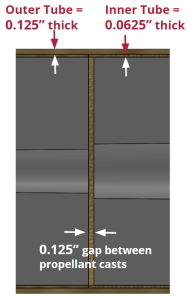
- bonding grain faces (epoxy) → new open motor design
- Test launch:
- planning to use the same case
- have long empty phenolic → changed to have normal phenolic length and push the forward closure down (spacer between the forward closure and FRR)
- CDR Desgin:
- Mix 1 (feb 7): (P motor and test launch)
- mid concial came back soft (forgot to put in plasticizer)
- why? chaotic mixing, added initial column to the table
- idea: more scales (one for each bowl)
- action: make lids for the vacuums, bring mixer up to larry's
- time line changes:
- previous timeline:
- only statiuc fiure p motor grain (same hardware)
- new timeline:
- static fire test launch grain (so we can be a go for test launch) → at mix 2 gonna mix mid conical AND new test launch grain (for launch)
- previous timeline:
- mid concial came back soft (forgot to put in plasticizer)
- Design Change: separate cases for test launch and P motor
- last year:
- hydrostatic tested without bolts torqued → leaked
- hydrostatic tested WITH bolts torqued → did not leaked
- So! thought would leak if the forward closure was super far from FRR (no clamping on orings from the bolts)
- last year:
- Hydrostatic 1 (test launch case, failure):
- observations:
- gapping between the lip of FRR and case, and lip of nozzle and case
- plastic deformation of holes in FRR and nozzle carrier
- friction!!! to stop the frr and the nozzle from moving! → thats where we get our torque requirement now. new complicated spreadsheet!
- observations:
- Mix 2 (feb 28th): (2nd test launch motor and mid conical)
- test launch grain different than static fire test launch grain
- redesigned to get more thrust of the rail
- inner phenolic tube for test launch grain was cracked → okay bc outer was not cracked and burnthru in 2-3 seconds would not happen
- test launch grain different than static fire test launch grain
- Static fire (test Launch) (3/14):
- yay!!! it worked!! but omg the pressure was 400psi higher than expected WATTTTTT (and shorter burn)
- mayyybeeeee hdyrostatic should go to 1.75 safety factor teehee (isntead of 1.5)
- we saw consistently that motors burn at higher pressures than simmed → widened nozzle throat diamter to lower pressure
- Static Fire (P motor) (3/21):

- it blew up
- had widened nozzle
- epoxied grain faces could have burned? but if they did would only have increased pressure by 100psi
- maybe propellant cracked from demandreling???
- case failure → net section failure on bolts, maybe some bearing failure first?
- countersinking too far?
- oring failure? → weakened aluminum
- rushed integration → probably saw an oring slice but didn't deintegrate
- path forward:
- make demandreling easier
- cast motor in one section
- reducing risk of over pressuriziation
- change bolt calcs to increase safety factors to normal levels
- always fucking retingrate if u see any specks whatsoever (uinless those specs or those in thr oring grease which are transulecent oh god)
- DONT rush integration
- clean area for bolts/generally icnreasig cleanliness → changed integration procedure
- Hydrostatic (test launch hardware):
- a couple bolt holes on the FRR plastical deformed like hdyrostatic 1, decided it was okay to move forward cus it was only a couple bolts and tilt was less severe than hyudrostatic 1
- Recharacterization → to be talked about later
- Test Launch yay!!!!
- no pressure data
- hey avionics can we please have a pressure transicer spot on avionics boards
- also not space with airbrakes? space on avionics?????
- no pressure data
- Mix 3: P motor
- mandrel improvements
- bit fillets (.15 radius)
- finocyl sectionw as slightly conical
- how conical?
- test in open motor → take average of fin width and core size for each ifnocyl section and plug those in to open motor, maybe instead trying to make Surface area match between open motor and reality isntead
- minimze gaps between sections (epoxy and sand smooth)
- sanded the whole mandrel to 400 grit sandpaper
- 10 layers of mold release (maybe 2 bottles total)
- mandrel improvements