Osiris is a 600 lbf Nitrous/IPA liquid rocket engine developed as the primary propulsion system for a future liquid bipropellant lander. The system features interchangeable ablative and regeneratively cooled combustion chambers, a pressure fed fluids system with active throttle valve control, a student-built test stand with TVC capability, and a modular, in-house data acquisition and control system built on a CAN bus.
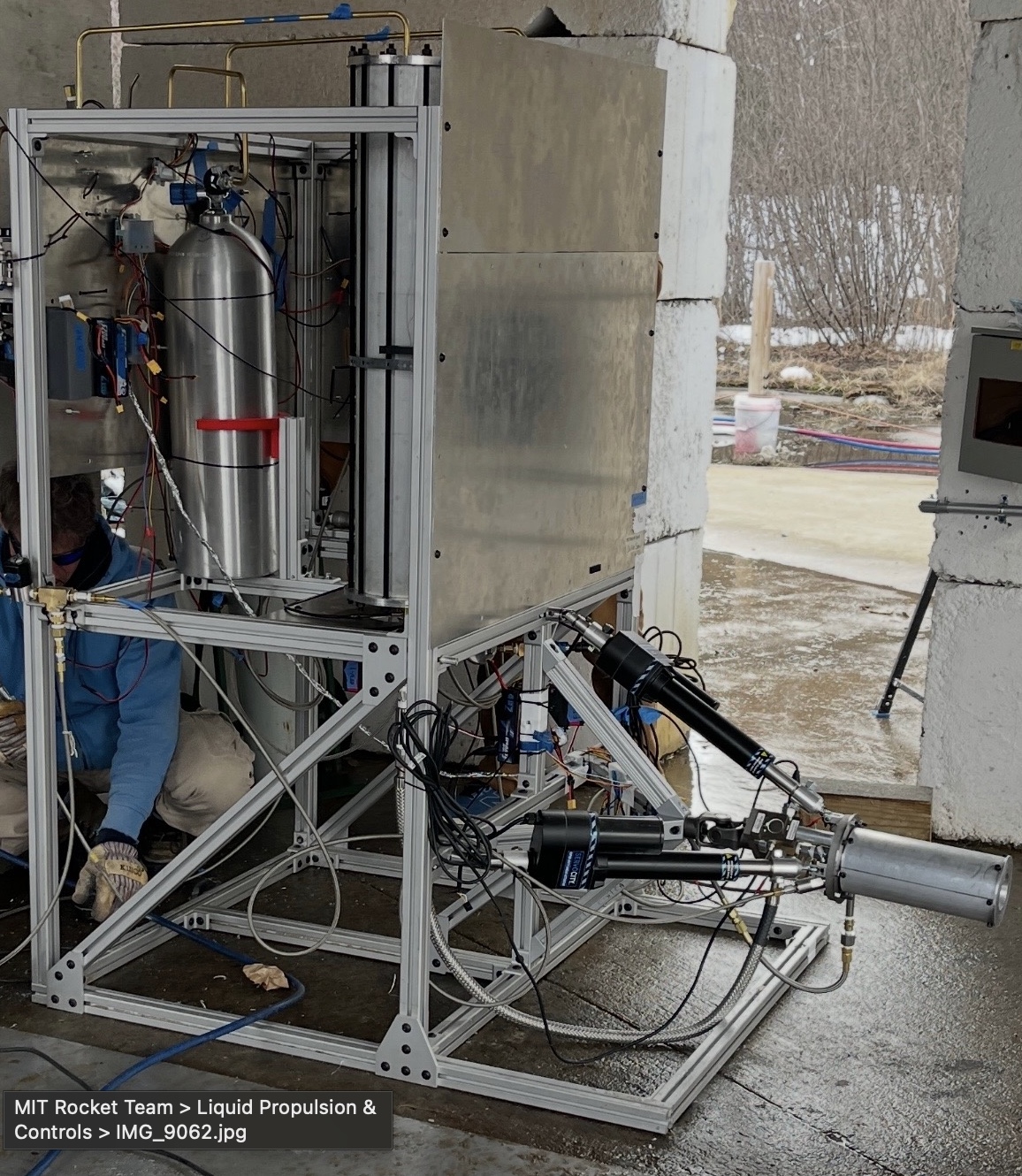
Following the issues encountered in pursuing a rocket project (Polaris), the team decided that developing more complex engines on the ground was the best way to grow team knowledge base exponentially. Although Polaris was an interesting and exciting project, it felt like we were trying to optimize a type of system without fully understanding how it worked yet. Prime examples of this were the fact that we needed to have everything inside a cylindrical airframe, which made integration more difficult, and also the fact that the system was dumbed down significantly to maximize apogee.
Instead of continuing on with a project that yielded increasingly marginal returns, the team opted to start the design of a new engine that was significantly more technically challenging but did not have some of the unnecessary constraints Polaris had. Project Osiris was chosen as a result of this philosophy, and also as a result of the team's growing interest in control systems. The idea of fusing liquids and controls was an exciting one, and it led to the creation of the Liquid Propulsion & Controls (LP&C) division, a subsection of RT competing in the Collegiate Propulsive Lander Challenge.
The project was initially intended to be "completed" over a one year design cycle, but now we realize that engine testing will need to happen right up until we integrate it onto the lander. However, the team was able to design the engine during the fall, manufacture it during IAP/the beginning of Spring, and start its testing campaign part-way through the Spring. This is a huge accomplishment, as the last static liquid engine developed by the team took 7 years to develop (albeit with COVID in the middle of that time frame), and was also a significantly simpler system than Osiris.
To develop a liquid engine in such a fast time frame, we also needed to streamline operations across logistics, procurement, and compliance. Thankfully I had a lot of foresight about potential non-technical blockers for such a project since June of last year, and have been working to streamline things ever since. The biggest things I was able to do were getting MIT to approve cylinder transportation in rental cars/U-Hauls, finding Linde cylinders that could hold more nitrous/have a shorter lead time/be cheaper, reestablishing the team's relationship with BluShift, and tracking purchases better (like a hawk) on buy2pay. I was also able to find a significant donor for the project.
Furthermore, to stick to our fast timeline, I also wanted to delete analysis paralysis from the team's conscience, which has been a large mental barrier for the team in previous years. For whatever reason, it seems like MIT students are more prone to wanting to verify every single little thing in CAD or in simulation instead of just testing it. I sought to build a culture that was more open to "sending it" for smaller scale testing even if we weren't 100% sure everything would work.
Currently, our goal for the end of the school year is to achieve a sustainable and reliable engine hot fire test cadence, where the team goes out to bluShift weekly or biweekly to hot fire Osiris. Usually, the days leading up to a major test are teeming with unreasonable amounts of work, but our metric of success is converging on a test cadence that does not require such strain from team members. A lot of hot fire testing needs to be done to be able to close the loop on throttle control; therefore, it NEEDS to be a sustainable process. We have an ablative chamber that we are using to perform throttle characterization, which will later be swapped with a flight ready regeneratively cooled chamber.
We also want to be able to do multiple hot fires per testing day at bluShift, to the point where we are constrained by time more than anything else. The engine has been rapidly converging to state where it is reliable enough to pass all preliminary system checks (such as leak testing and valve actuation) easily upon getting to the site, which opens the door for many hot fire attempts during the day. This is because the actual hotfire procedure only lasts around 30-45 minutes. Additionally, our new spark torch methagox igniter is designed to be 100% reusable, which will eliminate the need for any reintegration between hotfires.
All in all, I think Osiris has helped transform the culture of the team, and has provided a platform that allows young engineers to tackle difficult problems. Through Osiris, we have gone from a team who could barely make a Half Cat engine to a much larger and more knowledgable team that is always testing, iterating, and improving its systems.
Engine Requirements:
- The engine shall provide a thrust of at least 2.23 kN.
- The engine shall be capable of throttling down to 40% of nominal thrust, hold constant for 2 seconds, and then return to nominal thrust.
- The engine shall be capable of thrust vectoring at least 7 degrees in all directions.
- The engine shall be capable of completing a circular thrust vector profile in at most 10 seconds.
- The engine should be completed over a one year design, manufacture, and test cycle.
- The engine should be capable of a minimum of 30 hot fires without requiring major refurbishment or component replacement.
Engine Specifications:
- Thrust: 2.65 kN
- Propellants: Nitrous/IPA
- Mixture Ratio: 2.75
- Maximum burn time on test stand: 14 seconds
- Throttle Range: 40-100%
- Chamber Material: GrCop-42
- Total impulse on test stand: 38754 Ns
- Total impulse on lander: > 100000 Ns